Agile Methodology in the Age of AI: Musings from a Former Product Manager
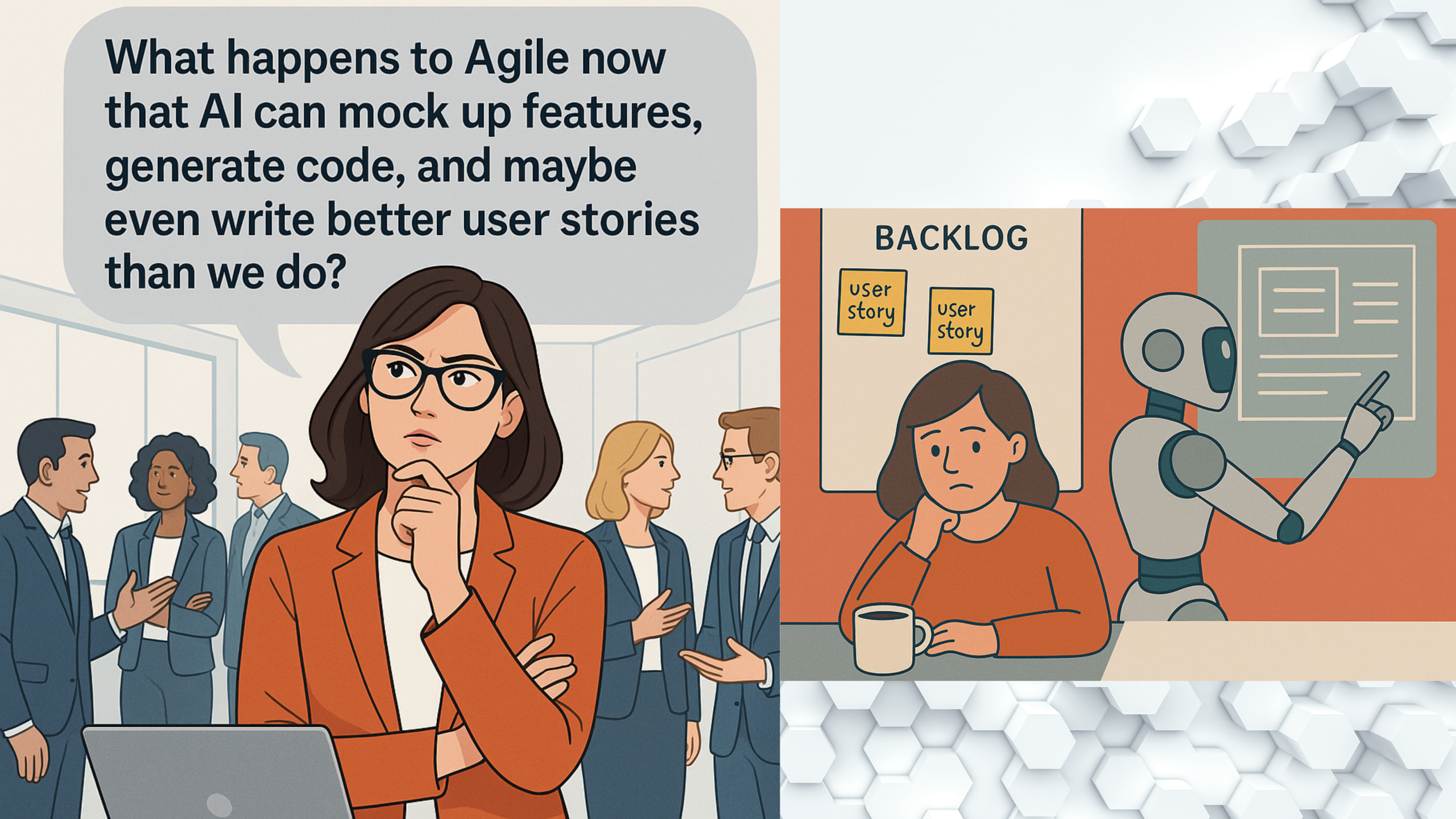
Table of Contents
Introduction
“Agile methodology taught us to embrace change. Now change shows up with an AI tag.”
It’s been a while since I sat through a sprint planning meeting, post-it notes in hand, juggling user stories, technical debt, and ever-slipping timelines. These days, I’m no longer managing roadmaps or chasing down JIRA tickets. But once a product manager, always a product thinker.
Lately, I’ve found myself wondering: What’s happening to Agile now that AI is no longer just a buzzword, but a working tool embedded in the enterprise product lifecycle—reshaping how both business and tech teams collaborate?
I don’t claim to have insider knowledge anymore—but from where I stand, watching the tech world swirl forward, here are a few of my quiet musings on how things might be shifting.
When Business Users Become Builders
When business users become builders, the first version of the product might arrive
before the first standup.
One shift I can’t stop thinking about is the quiet transformation of the business user. In the past, business stakeholders discussed their requirements, reviewed prototypes, provided input during Sprint demos, executed some user testing before a product release. But today?
With generative AI tools, low-code platforms, and no-code mockup builders, I suspect business users are no longer standing on the sidelines—they’re rolling up their sleeves and building the first version themselves.
Tools like Base44, for instance, promise end-to-end app development without needing a full engineering team. And generative AI can spin up data models, UIs, and workflows from just a prompt or a conversation.
So what happens when use case writers become mockup creators? When business users don’t just define the “what” but also produce a working proof-of-concept?
My guess? The lines between business and tech teams are blurring—fast.
And while that might feel threatening to some traditional roles, I actually find it kind of thrilling. It could mean faster iteration cycles, tighter feedback loops, and more ownership across the board.
Of course, we’ll still need skilled product thinkers and engineers to scale, secure, and steward the vision. But I wonder if we’re heading into a world where cross-functional collaboration starts with creation, not just conversation.
Backlogs Might Now Have a Brain
Back in my day (which wasn’t that long ago), grooming the backlog was a delicate art. It took intuition, customer empathy, a few rounds of debate, and a healthy helping of guesswork.
Now I imagine AI tools scanning customer feedback, support tickets, and usage data—auto-suggesting user stories, even writing acceptance criteria drafts.
What was once a sticky-note sea might now be a prioritized, machine-curated stream. And that feels… both magical and a little eerie.
Sprint Planning Could Be Less of a Guessing Game
Sprint planning always relied on a mix of historic velocity and team gut feel. I can’t help but think AI’s predictive capabilities are now in the mix—analyzing patterns, flagging risk, suggesting when teams might be overloaded before they even realize it.
Does that take the fun out of it? Or the anxiety? Maybe a bit of both.
Standups That Write Themselves?
There were always a few standups where everyone just said, “same as yesterday.” I wonder if now, AI tools summarize task progress, highlight blockers, and make sure no one’s slipping silently behind.
Is it possible some teams are skipping live updates altogether? Letting dashboards speak for themselves?
I don’t know. But I imagine it must change the nature of those daily 15–30 minutes.
QA Could Be Happening in Real Time
If AI is writing test cases as code is written, and flagging anomalies before a human even hits “run tests,” then the QA bottleneck I once feared every sprint… might now be a smoother stream.
Testing was always the fragile bridge between building and releasing. Maybe now it’s more of a moving walkway.
Retrospectives with Metrics, Not Just Memories of Lessons Learnt
I remember retrospectives filled with good intentions and sometimes vague takeaways: “Communicate more.” “Scope better.” “Celebrate wins.”
But what if AI tools are analyzing sprint activity, commit behavior, or even Slack sentiment—and surfacing real, sometimes uncomfortable, truths?
Would that make retros more honest? Or more robotic? I’m not sure. But I’d love to be a fly on the wall.
The Role of the Product Manager Might Be Morphing
Here’s one thought I keep circling back to: in a world where AI tools can analyze feedback, generate stories, plan sprints, and write tests—what becomes of the product manager? Maybe the product manager becomes more of a sensemaker than a task driver. Less “What should we build?” and more “Why does this matter?”
The human skills—storytelling, vision-setting, stakeholder diplomacy—might be even more important now that machines can handle the operational load.
Just My Musings from the Sidelines
I’m not in those Agile rooms anymore. I don’t see these changes firsthand. But I still do sometimes think like a product manager, and I can’t help wondering how my old rituals are being reshaped by this new AI era.
Agile was always about responding to change. Well—here’s change, wearing a neural network and a predictive algorithm. The trick, I imagine, is to let AI sharpen the process—but not dull the human spark.
Are you seeing these shifts where you work? What’s changing in your team’s Agile rituals—if anything? Let’s muse together. Comments always welcome.