The Astonishing Journey of Madras Check Fabric: From Everyday India to America’s Preppy Style
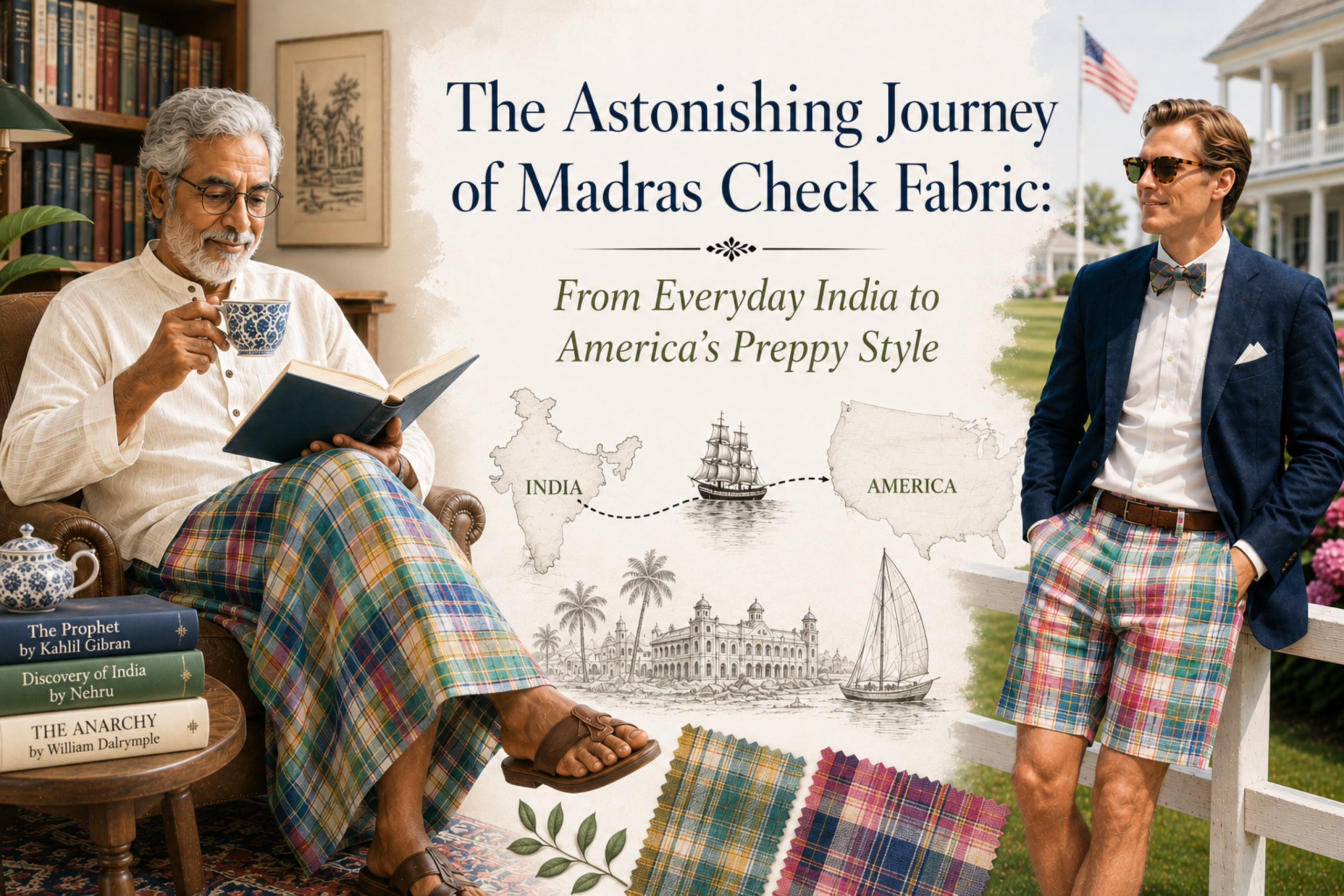
Table of Contents
Introduction
Some of the world’s most extraordinary stories begin with things we barely notice.
Growing up in India, the checked ‘lungi’ or ‘dhoti’ was one of those things.
That gloriously comfortable, breezy cotton cloth (like a sarong) worn by millions of Indian men (or at least it certainly was when I was growing up) while lounging at home, drinking chai, reading the newspaper, riding bicycles, bargaining in fish markets, repairing electrical wires, or simply surviving ninety-degree humidity.
To my Indian brain, the lungi was never fashion. It was practicality and comfort. Climate engineering. Humidity survival technology. And certainly not luxury. Here is more about the lungi on wikipedia.
So imagine my complete astonishment recently when I fell down an online rabbit hole and discovered that this very same visual language – the famous Madras check (or simply ‘Madras’), somehow traveled from the humid coasts of South India all the way to the polished lawns of Yale University, Ivy League prep culture, wealthy New England summer homes, American country clubs, and the wardrobes of the global elite.
I almost fell off my chair. Excuse me?
You’re telling me that those stylish “preppy plaid shorts” that I see so many American men wearing around here in New England have ancestral DNA connected to the lungis I watched countless Indian uncles wearing while riding bicycles, drinking filter coffee, selling fish at the market, or simply relaxing at home?
It may be one of the most surprising textile reinventions I’ve ever come across.


Men in lungis from the Indian sub-continent (Image source: wikipedia)

Bales of the handmade cotton textile from India
Wait… “Madras” Means Madras?
Yes. Literally.
Madras check gets its name from Madras, the colonial British name for present-day Chennai in South India.
According to my online sleuthing, the fabric originated along the Coromandel Coast, where Indian weavers had been producing lightweight handwoven cotton textiles for centuries. The climate mattered enormously. South India is hot, coastal, sticky, and humid for much of the year, so people needed fabrics that breathed.
Local artisans created airy cotton cloth woven into checks, plaids, stripes, and grids, dyed with vibrant natural colors. The fabric was functional, breathable, washable, affordable—and also unexpectedly beautiful.
Because the dyes were applied by hand using traditional techniques, the colors often appeared slightly uneven or softly faded. Sometimes they even bled during washing. To Indians, these were simply characteristics of handmade cloth.
Much later, Western consumers would reinterpret those very same imperfections as signs of artisanal authenticity, handcrafted luxury, and relaxed elegance.
That irony alone deserves a documentary. For now, I’ve summarized some of the most fascinating things I learned while researching this remarkable story.
What Does Yale Have to Do with Madras?
And now comes the part that genuinely surprised me. The name Yale actually connects back to Madras.
The university was named after Elihu Yale, a British administrator with the East India Company who served as Governor of Madras during the late seventeenth century.
While in India, Yale accumulated considerable wealth through the East India Company’s trading networks operating from Madras, where cotton textiles—including the kinds of handwoven fabrics for which the region later became famous, were among its most important exports. Later, he donated goods and merchandise from Madras to the struggling Collegiate School in Connecticut. Those donations helped support the institution financially, and the school was eventually renamed Yale College in his honor.
I don’t mean to suggest that Yale somehow “invented” Madras style. Far from it. What fascinated me was simply realizing that one of America’s most iconic universities and one of its most iconic summer fabrics both have historical ties to the same South Indian city. As someone who grew up in India and now lives in New England, that was a connection I had never made before.
So, in one of history’s most unexpected cultural loops, a textile tradition born on India’s Coromandel Coast would eventually become one of the defining fabrics of Ivy League style.
How Madras Became the Fabric of Summer Wealth
By the middle of the twentieth century, Americans, especially those living on the East Coast, became enchanted by Madras fabric.
Why?
Because it represented almost everything traditional Western menswear did not. At the time, American and European fashion leaned heavily toward dark wool, rigid tailoring, seriousness, and structure. Then along came Madras: bright, soft, tropical, relaxed, and beautifully imperfect. It looked like summer itself.
Its corals, mint greens, sun-washed yellows, ocean blues, and soft pinks felt perfectly at home beside sailboats, beach houses, cocktails, and Atlantic coast vacations.
Madras gradually became the visual language of wealthy summer leisure. It appeared on Ivy League campuses, yacht clubs, golf courses, Cape Cod vacations, Martha’s Vineyard weekends, and eventually throughout North America.
Which honestly makes this story even more interesting to me. Because somewhere in another tropical universe, an Indian grandfather like mine was wearing his lungi for an afternoon nap, unknowingly sharing the same textile heritage that would later inspire elite American resort fashion.
“Bleeding Madras” – When the Flaw Became the Feature
One of the most unbelievable parts of this story is the famous phrase: “Guaranteed to Bleed.”
During the 1960s, authentic Madras fabric imported from India became wildly fashionable in American preppy culture. There was just one problem – the traditional vegetable dyes often weren’t completely colorfast. When washed, the colors would bleed, soften, fade, and transform unpredictably.
Ordinarily, that would have been considered a manufacturing defect. Instead, clever marketers and enthusiastic consumers turned it into a virtue.
People loved that every shirt, skirt, pair of shorts, or summer dress aged differently. The fading gave each piece its own personality, like weathered beach cottages or sun-bleached umbrellas along the New England coast.
Eventually, authentic Madras was proudly sold with the label: “Guaranteed to Bleed.” The flaw became the feature.
Looking back, this feels remarkably modern. Long before terms like slow fashion, wabi-sabi, handcrafted authenticity, and artisanal irregularity became fashionable marketing language, Madras had already embodied those ideas.
The Great Madras Makeover
Honestly, the entire transformation feels cinematic.
A humble checked cotton cloth designed to survive Chennai’s humidity eventually evolved into tailored blazers, luxury shorts, resort dresses, summer skirts, yacht-party shirts, handbags, pocket squares, and country-club fashion.
The same visual language traveled across climates, classes, continents, empires, and centuries. In India, it was comfortable everyday clothing. In America, it became summer sophistication. That is not simply fashion evolution. It is cultural alchemy!
The Brands That Turned Madras Into Preppy Royalty
Some of America’s most recognizable fashion brands helped transform Madras into a preppy icon. For example, Brooks Brothers. J.Crew. Ralph Lauren. Vineyard Vines. Tommy Hilfiger. Southern Tide.
Madras appeared on Bermuda shorts, button-down shirts, summer blazers, sundresses, skirts, golf apparel, and resortwear.
What fascinates me most is that the fabric somehow managed to remain both elite and casual at exactly the same time.
My Biggest Realization
What surprises me most is how often India’s everyday design language quietly enters global culture without many Indians fully realizing its influence (including myself).
Growing up, Madras checks felt almost invisible to me because they were everywhere. They were simply part of the visual background of everyday life.
I suspect this happens more often than we realize. When we grow up surrounded by something, it becomes ordinary to us. We stop seeing it. Sometimes it takes another culture to admire what we’ve taken for granted before we can see it with fresh eyes ourselves.
Perhaps that’s why this story stayed with me.
One day you’re watching uncles in checked lungis riding bicycles through humid Indian streets. Years later, you’re living in New England and seeing remarkably similar checks on beautifully tailored shorts outside yacht clubs, summer weddings, and college campuses.
And then one day you stop and think:
Wait a second…
That stylish preppy plaid everyone romanticizes?
That came from India.
From Indian humidity.
From Indian cotton.
From Indian weavers.
From the streets of Madras.
From generations of people solving a very practical problem: how to stay cool in tropical heat.
Perhaps that’s the part of the story I love most. What the world eventually celebrated as timeless summer style began as something much simpler: centuries of local craftsmanship, climate wisdom, and everyday ingenuity quietly woven into a humble piece of cotton cloth.
Sometimes the most ordinary things carry the most extraordinary journeys. We just don’t notice them until they leave home.