The Spanish Masters I Didn’t Know I Was Missing

From Boston to Madrid: A Personal Reflection on Art, Cultural Memory, and How Certain Artists Become Household Names
Table of Contents
Introduction
On my recent trip to Madrid with a group of girlfriends, all of us trained in architecture and design, we had the pleasure of visiting two extraordinary museums: the Prado and the Reina Sofía. Both are world-class institutions, but they tell very different stories about art. And I came away with a question I hadn’t expected to ask.
Why were Picasso, Miró, and Dalí already so familiar to me, while El Greco, Velázquez, and Goya—whose paintings moved me far more deeply, felt like discoveries? Why had my years of visiting American museums exposed me so much more frequently to the former than the latter?
This was not a question about which museum was better, or even which artists were greater. It was about the curious difference between an artist’s greatness and how we come to know that greatness.
The Art That Stayed With Me
I expected to appreciate the Prado. What surprised me was the depth of my response to it. The paintings of El Greco, Velázquez, and Goya held my attention through their stories, colors, emotion, and extraordinary understanding of human drama.
There was also something deeply moving about the religious paintings, particularly the way they portrayed the life of Jesus Christ. Beyond their artistic beauty, these biblical scenes captured universal human emotions—love, tenderness, suffering, sacrifice, and hope. The stories felt remarkably intimate and timeless, transcending their religious context.
In El Greco’s The Holy Trinity, God the Father holds the body of Jesus, surrounded by angels and extraordinary color, while the Holy Spirit appears as a dove above them. I found the image of divine love conveyed through grief especially powerful. It is a theological scene, yet its emotion is so recognizably human.

Velázquez’s Christ Crucified takes almost the opposite visual approach. There are no crowds or elaborate surroundings—only Christ against a dark background. Its quiet restraint leaves little between the viewer and the subject. The simplicity is what gives it force.

Not everything at the Prado was religious, of course. Goya’s The Third of May 1808, with the condemned man in white confronting a firing squad, is a portrayal of war and human cruelty that feels painfully immediate. The white shirt, the outstretched arms, the light against darkness: the painting tells its story before one even knows the historical context.
These artists were not merely painting beautiful figures. They were making us feel the human condition.

Then Came the Museum Reina Sofía
At the Reina Sofía, I encountered another remarkable chapter of Spanish art. Picasso, Miró, and Dalí were undeniably inventive, and I understand why Cubism and Surrealism were revolutionary. Yet I did not connect with them in the same way. The fractured figures of Cubism and the unsettling worlds of Surrealism sometimes felt cold to me, almost dysfunctional. I admired the intelligence behind the work more than I felt moved by it.
I know this is a personal reaction, not a judgment on their artistic achievement. Picasso’s Guernica, for example, is an anguished response to the devastation of war. It is full of human suffering, but its language is fragmentation and distortion. Goya also portrayed the horrors of violence, his visual language reached me more directly. Two artists, separated by more than a century, were confronting human cruelty in profoundly different ways.
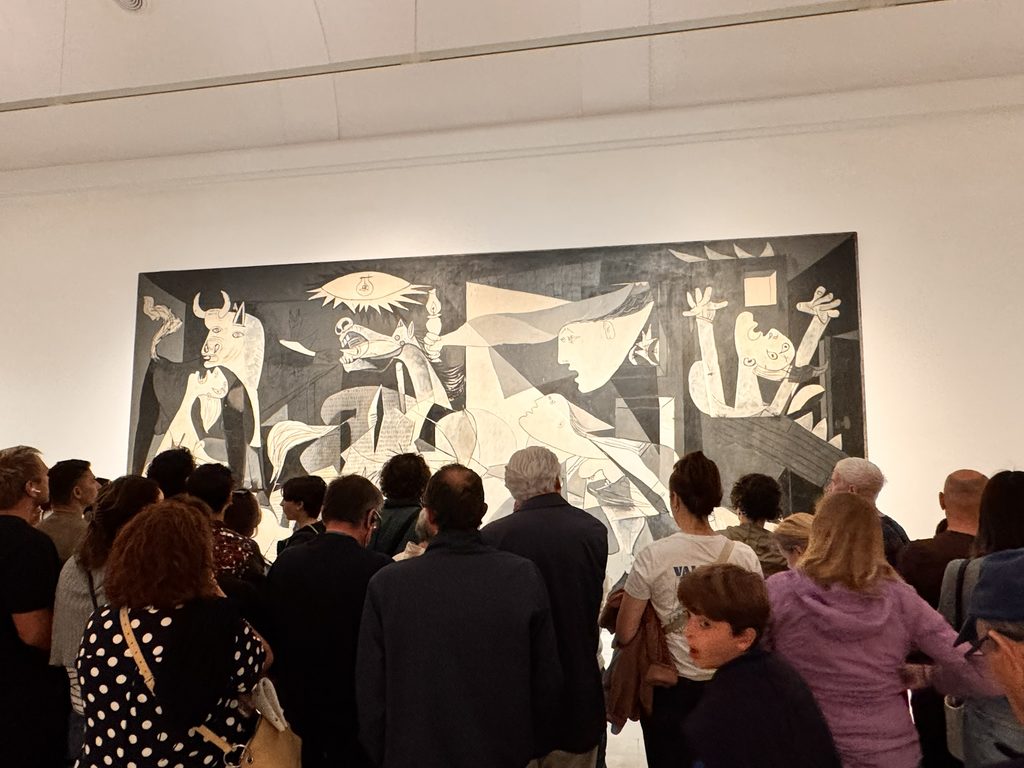

What interested me almost as much as that contrast was the familiarity of the modern artists’ names. Picasso, Dalí, and Miró seemed to have become part of the common vocabulary of art, particularly in the United States. Their work appeared not just in museums but in books, design, film, and popular culture.
And then I began thinking about my own experiences with their work before I ever set foot in Madrid.
My Familiarity with Spanish Modern Art Began in America
Over the years, on my many visits to the Museum of Fine Arts in Boston, I had frequently encountered original Picasso paintings in its modern art galleries. Just before my Madrid trip, I also visited the MFA’s special exhibition Picasso, Miró, Dalí: Unbound (August 1, 2026–January 24, 2027), which explored illustrated books created by these artists in collaboration with writers and printmakers. I particularly enjoyed the intersection of art, typography, and literature.


My recent visit to the Picasso, Miro, Dali: Unbound, temporary exhibit at the MFA Boston.
A few years earlier, I had also visited the Salvador Dalí Museum in St. Petersburg, Florida. An entire American museum dedicated to a Spanish artist! I was already familiar with Dalí’s extraordinary Surrealist imagination and even have photographs from that visit.


Photos from my trip to Dali Museum in St. Petersburg, Florida in 2023.
By the time I arrived in Madrid, Picasso, Miró, and Dalí were already familiar to me. But the Prado was a revelation. Although I knew of El Greco, Velázquez, and Goya, I had never encountered such an extraordinary concentration of their masterpieces. It made me wonder whether my experience reflected something larger about how American museums shape our familiarity with art.
Why Did Spain’s Modern Artists Become So Famous in America?
As I explored this question, I discovered that the rise of modern art in twentieth-century America played a significant role. Institutions such as New York’s Museum of Modern Art (MoMA) actively championed European modernists. Picasso’s landmark 1939 retrospective introduced his work to wider American audiences, while his famous Guernica remained at MoMA for decades before returning to Spain in 1981.
Miró also received major exhibitions at MoMA, including a 1941 retrospective, while Dalí became a celebrity through his flamboyant personality, publicity, and Hollywood connections. Interestingly, American collectors Reynolds and Eleanor Morse discovered Dalí’s work at a traveling exhibition in 1942, eventually building the collection that became the Dalí Museum in Florida.
Beyond museums, their distinctive visual styles – Picasso’s fractured faces, Miró’s colorful symbols, and Dalí’s melting clocks, became recognizable through books, posters, design, and popular culture.
These artists were already celebrated in Europe, but American museums, collectors, and media helped establish their place in the American cultural imagination.
Perhaps repeated exposure had made these artists feel familiar to me long before I visited Spain.
Back to Boston: A Hypothesis Takes Shape
Living near Boston, I have often admired Italian Renaissance and Dutch Golden Age paintings at the MFA and Isabella Stewart Gardner Museum, but encountered comparatively few Spanish Old Masters. Madrid made me wonder whether these artists are less familiar to American museumgoers because their masterpieces have been less visible here.
One explanation lies in where their works remained. The Prado, built on Spain’s royal collections, holds 48 paintings by Velázquez—nearly 40% of his known output—and 130 by Goya. American museum collections, meanwhile, reflect different histories of patronage and collecting. In 2017, for example, the MFA announced a landmark gift of more than 110 Dutch and Flemish paintings from two Boston-area collecting families.
New York offers an important exception. The Metropolitan Museum of Art, Hispanic Society Museum & Library, and Frick Collection hold remarkable Spanish Old Master paintings, all now on my agenda for my next New York visit!
Yet encountering individual masterpieces scattered across American museums is quite different from experiencing such an extraordinary concentration at the Prado. Perhaps that is why the achievements of these Spanish masters felt like such a revelation to me.
But Then I Thought About Michelangelo
As I continued thinking about this, I realized there was a problem with my own explanation. What about Michelangelo? Or Leonardo da Vinci and Raphael?
They too worked for the Catholic Church, popes, and wealthy patrons. Many of their most celebrated works have never left Italy. And yet in America their names are familiar even to people who rarely visit art museums.
Take Michelangelo’s Creation of Adam. Those two hands reaching toward each other are among the most recognizable images in Western culture, reproduced on everything from art-history textbooks to posters.

But the original is a fresco on the Sistine Chapel ceiling in the Vatican. It has never been hanging in a Boston or New York museum. The Kimbell Art Museum in Texas describes its Torment of Saint Anthony as the only Michelangelo painting in an American collection.
So clearly, the number of original paintings in American museums cannot be the whole answer. An artist can become a household name even when their masterpieces remain an ocean away.
Perhaps the real question is not only where the paintings traveled, but how the stories about the artists traveled.
Who Helped Write the Story of Great Art?
Part of the answer goes back to the Renaissance itself. In 1550, Giorgio Vasari published Lives of the Artists, a foundational work of art history that celebrated Italian painters, sculptors, and architects, giving particular prominence to Florence and masters such as Michelangelo. Long before American museums existed, Italian Renaissance art had become central to the story of Western artistic genius.
Then came the Grand Tour, an educational tradition among wealthy Europeans from the seventeenth through the nineteenth centuries. Italy, particularly Rome, Florence, and Venice, became an essential destination for studying classical civilization, art, and architecture. Spain, although visited by some travelers, remained largely outside the traditional Grand Tour itinerary. These traditions helped establish which artists and cultural achievements were considered essential to a European education, an outlook that subsequently influenced American perceptions of Western art.
American collectors reinforced this legacy. Samuel H. Kress, for example, assembled an extraordinary collection of Italian paintings, donating about 375 to the National Gallery of Art by its opening in 1941. Many more were distributed to museums across the country, giving Americans opportunities to encounter Italian Renaissance masterpieces.
Spanish masters also influenced European artists like Manet and Delacroix and American painters such as John Singer Sargent and Whistler. Yet despite their artistic importance, El Greco, Velázquez, and Goya may still be less familiar to the average American than Michelangelo or Picasso.
What We Can Photograph, and What We Share
Another detail from Madrid seemed relevant. The Prado prohibits photography in its galleries, while the Reina Sofía generally allows it without flash. Two neighboring museums, two different approaches to sharing art.
As someone who enjoys photography, I wondered whether this affects how widely artists become known today. Photos shared with friends or on social media can introduce new audiences to unfamiliar masterpieces. Perhaps the Prado’s restrictions limit this kind of exposure for the Spanish Old Masters.
Of course, putting away our cameras encourages us to slow down and appreciate the art. The Prado also shares its collections online and has explored photography’s historical role in spreading art through its 2026 exhibition, The Prado Multiplied: Photography as Shared Memory.
Still, in today’s image-driven world, I wonder whether photography policies influence which artworks become part of our shared cultural awareness.
A Conversation Across Centuries
One fascinating discovery connected the two museums: Picasso studied the Spanish Old Masters at the Prado. In 1957, Picasso created about 45 interpretations of Velázquez’s Las Meninas. El Greco’s expressive forms also influenced modern artists. Rather than replacing the Old Masters, the modernists were in conversation with them.

While I admired the modernists’ innovations, the Prado’s stories, colors, humanity, and spiritual depth moved me far more deeply. It also made me question why these extraordinary artists had been less familiar to me.
My hypothesis evolved beyond where masterpieces are housed. Art education, museum collections, cultural institutions, and even the images we share all influence which artists become household names.
Having encountered Picasso repeatedly in Boston and Dalí in Florida, it took a visit to Madrid to fully appreciate their Spanish predecessors.
I left with respect for both museums, but my heart remained at the Prado.
Who shapes our shared cultural memory of great art, and which extraordinary artists are we still waiting to discover?
References and Further Reading
- Museo Nacional del Prado. Spanish Painting — The Collection. Overview of the Prado’s Spanish masters, including its holdings of Velázquez and Goya.
- Museum of Fine Arts, Boston. Picasso, Miró, Dalí: Unbound. Exhibition, August 1, 2026–January 24, 2027.
- Museum of Fine Arts, Boston. Landmark Gifts of Dutch and Flemish Art. Announcement of the 2017 gift from the Van Otterloo and Weatherbie collections.
- Museum of Modern Art, New York. Picasso: Forty Years of His Art (1939–1940) and Joan Miró (1941–1942). Two landmark exhibitions promoting Spanish modernism in America.
- The Dalí Museum, St. Petersburg, Florida. Mission and History. The museum’s origins and the collection assembled by Reynolds and Eleanor Morse.
- The Frick Collection, New York. Velázquez in New York Museums. An exhibition highlighting major Velázquez paintings in New York’s Met, Hispanic Society, and Frick collections.
- Kimbell Art Museum, Fort Worth. Michelangelo — The Torment of Saint Anthony. Information about the only Michelangelo painting in an American collection.
- The National Gallery, London. Giorgio Vasari (1511–1574). Background on Vasari and his influential Lives of the Artists.
- The Metropolitan Museum of Art. Jean Sorabella, The Grand Tour (2003). The historical importance of Italy in European cultural education and travel.
- National Gallery of Art, Washington, DC. History of the Collection: Italian Paintings. The role of Samuel H. Kress in bringing Italian masterpieces to American museums.
- Museo Nacional del Prado. The Prado Multiplied: Photography as Shared Memory (2026). An exploration of photography’s historical role in circulating images of the Prado’s masterpieces.
- Museo del Prado and Museo Reina Sofía. Prado Visitor Photography Rules and Reina Sofía Visitor Information. Official museum photography policies.
- Museu Picasso, Barcelona. Picasso’s Las Meninas Series. Picasso’s 1957 reinterpretations of Velázquez’s masterpiece.


