I went to the Museum of Fine Arts expecting to see how Asian art had traveled west. What I discovered was a far more intriguing story: art does not merely travel. It is translated, reimagined, and made new wherever it lands.
On August 20, I visited the Museum of Fine Arts, Boston, with one particular gallery in mind: Asian Styles in the Americas, part of the museum’s Art of the Americas Wing.
My interest in the exhibition was personal. Through my long association with Xiang Li’s Chinese watercolor paintings—her portraits of Chinese empresses, and her many paintings of Guanyin, the bodhisattva of compassion—I have gradually learned to look at Chinese visual culture with greater attention. Details I might once have regarded as merely decorative now feel full of meaning: the fall of an empress’s robe, a flower chosen for its symbolism, the curve of a mountain, an animal carrying an ancient association, or the serene downward gaze of Guanyin.
That association has also changed the way I enter a museum. I no longer see an object as something complete and self-contained, resting quietly behind glass. I find myself wondering about the hands that made it, the traditions those hands inherited, the route the object traveled, and what happened to its meaning along the way.
The gallery places Asia and the Americas within the same eighteenth-century story of trade, artistic invention, labor, and cultural exchange.
The Story I Thought I Knew: Asian Art’s Journey West
Before this visit, I knew, in a general way, about the tremendous appetite for Chinese objects in Europe and the Americas. Porcelain, lacquerware, painted screens, silk, tea wares, lamps, and vases crossed oceans through expanding trade networks. Chinese porcelain became so closely associated with its country of origin that, in English, we still casually call fine porcelain “china.”
I had also seen evidence of this fascination much closer to home. In historic New England houses—the Codman Estate in Lincoln, the great mansions of Newport, and other homes shaped by the wealth and tastes of the late nineteenth and early twentieth centuries—Chinese and Chinese-style objects appear with striking frequency. A porcelain vase rests on a mantel. A painted screen divides a room. A lampshade, cabinet, or wall covering evokes an imagined China of pagodas, flowering branches, birds, and distant landscapes.
I had always assumed that most of these objects had been made in China by Chinese artisans and then exported to Western buyers. Many of them, of course, were. But the MFA gallery unsettled the simplicity of that assumption.
Blue-and-white ceramics made across China, Japan, Korea, Vietnam, Mexico, Iran, Türkiye, and Europe reveal how widely forms and motifs circulated—and how misleading a single label such as “fine china” can become
What surprised me was not simply that Asian objects had crossed the oceans, but that Asian ideas had taken root in the Americas—where artists studied them, adapted them, and created entirely new forms.
I first thought of this as a kind of reverse “brain drain.” But what I encountered was richer and less linear: a reverse current of influence within a vast, multidirectional exchange. Artists in China sometimes adapted European forms for foreign buyers. Chinese carving traditions traveled to the Philippines. Makers in colonial Mexico combined Asian, European, and Indigenous ideas. Boston craftspeople recreated the appearance of lacquer with local materials. No single culture remained only the giver or only the receiver.
A Virgin Mary Who Reminded Me of Guanyin
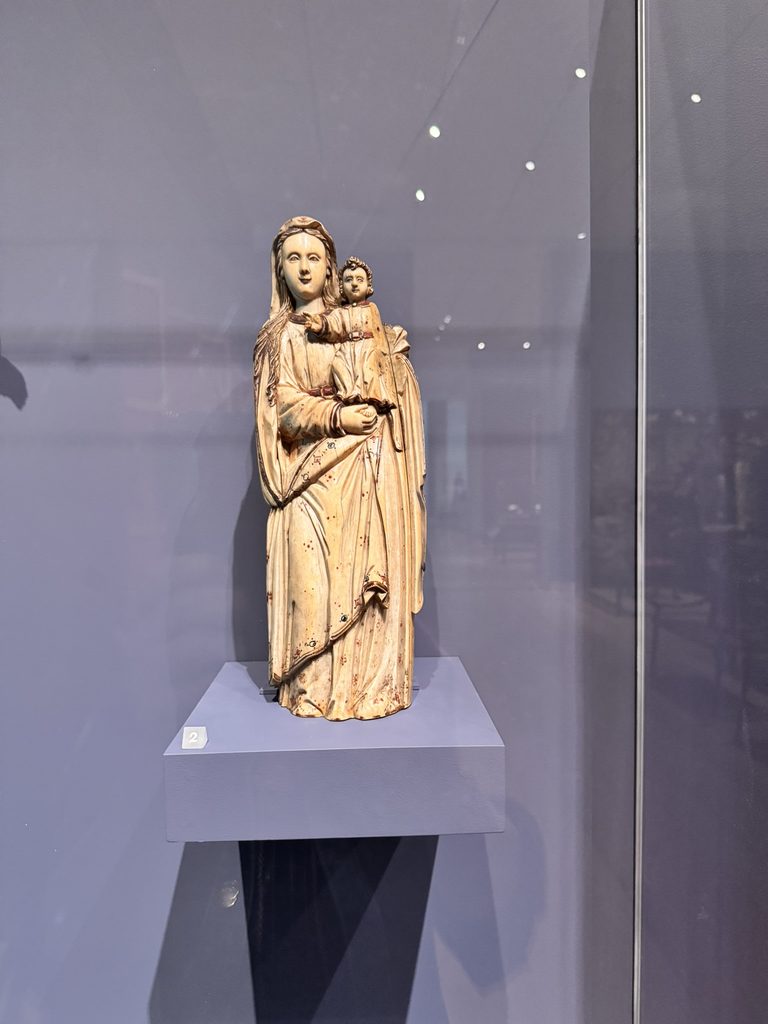
Virgin and Child at the MFA Exhibit, Philippines, 1600s, ivory. The figure was inspired by European prints while also bearing a resemblance to East Asian statues of Guanyin (below).
Depictions of the Goddess of Mercy, Guanyin, by artists of Song and Qing Dynasties of China. Do you see the resemblance of this deity in the Virgin Mary carving above? Image Source: Wikipedia.
Of all the objects in the gallery, one small ivory figure made me stop for several extra minutes: the Virgin Mary holding the Christ Child, carved in the Philippines during the 1600s.
The museum label explained that Chinese sculptors had carved elephant tusks since the Song dynasty and brought their craft to the Philippines, where this sculpture was likely created. These Christian figures at the exhibit were inspired by European prints, yet their features and bearing also resemble East Asian statues of Guanyin—the bodhisattva of compassion, often represented in feminine form and sometimes shown with a child.
Because I have spent so much time with Xiang Li’s paintings of Guanyin, I recognized something familiar in the figure’s quiet composure. The subject was Christian, but the emotional language seemed to cross religious boundaries: the protective closeness of mother and child, the gentle stillness, the embodiment of mercy in human form.
I found the sculpture moving precisely because it did not belong neatly to one world. It carried a European sacred story, Chinese carving knowledge, a Philippine place of making, and the visual memory of Guanyin. It was not simply an example of one culture copying another. It was an artist searching within an inherited language of gesture, expression, and touch for a way to make a new image intelligible.
Perhaps this is what art can do when geography or doctrine keeps traditions apart: it discovers a gesture that can travel. The figure made me wonder: when an image of compassion passes from one faith into the visual language of another, has it lost its origin—or revealed something universal beneath it?
Two Folding Screens, Talking Across Borders
Two folding screens offered the clearest visual lesson in how cultures look at one another—and how those acts of looking are never neutral.
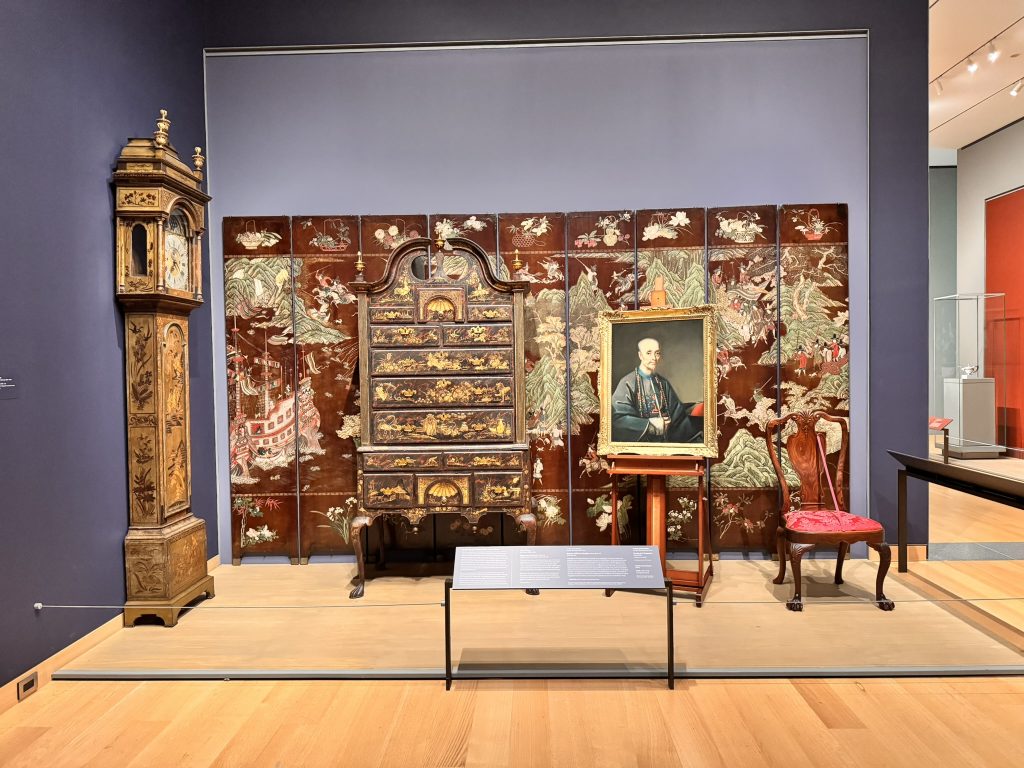
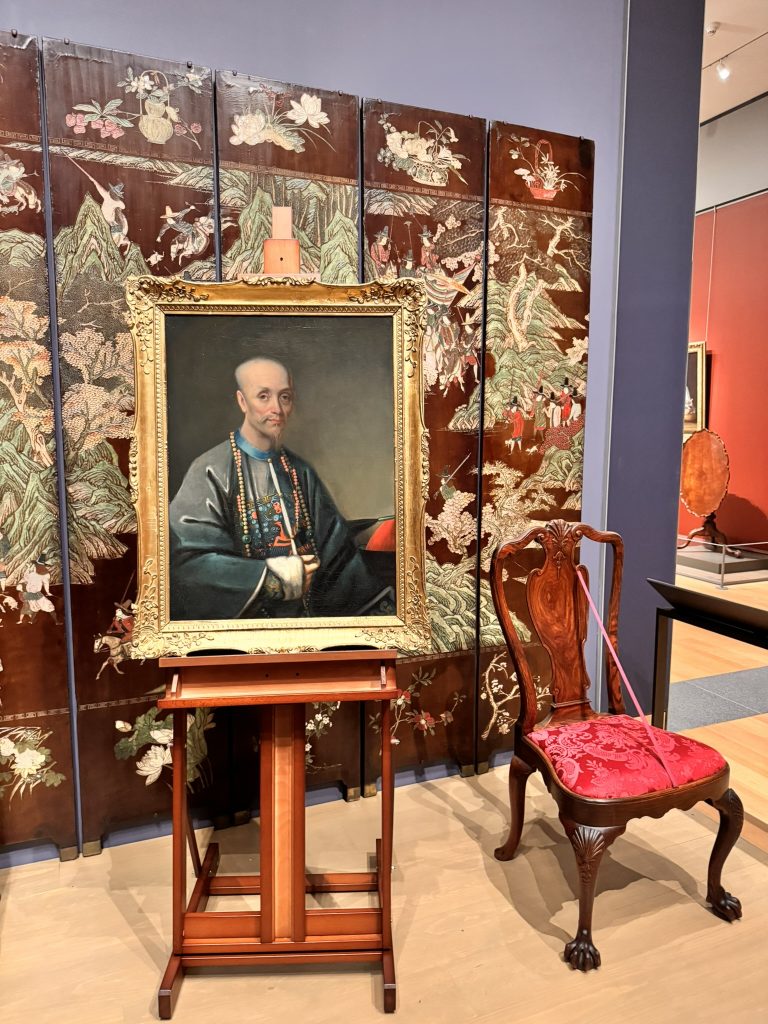
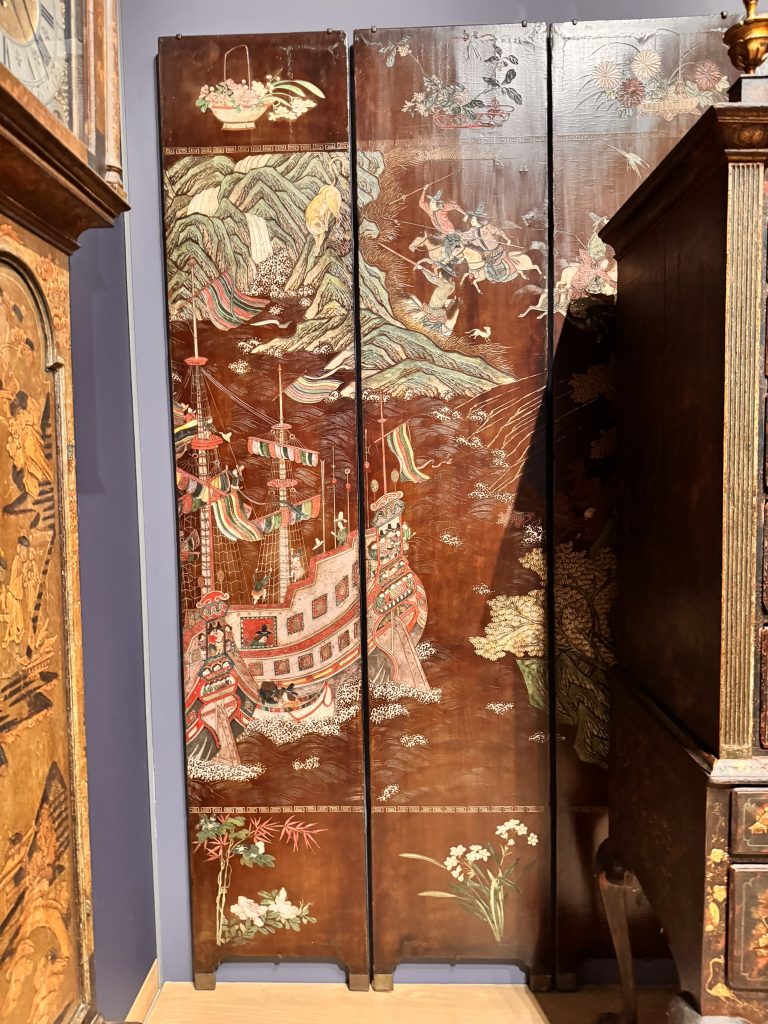
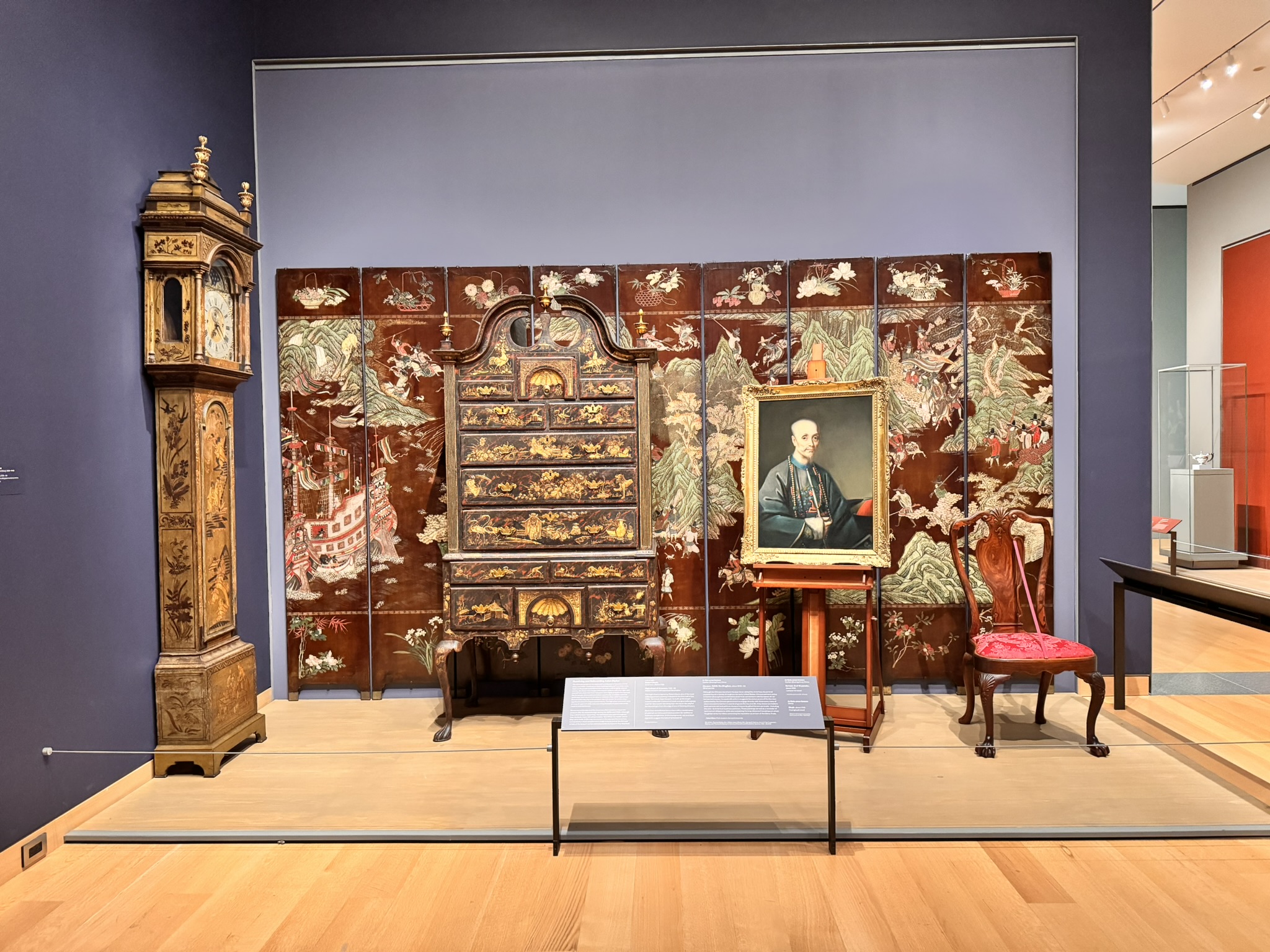
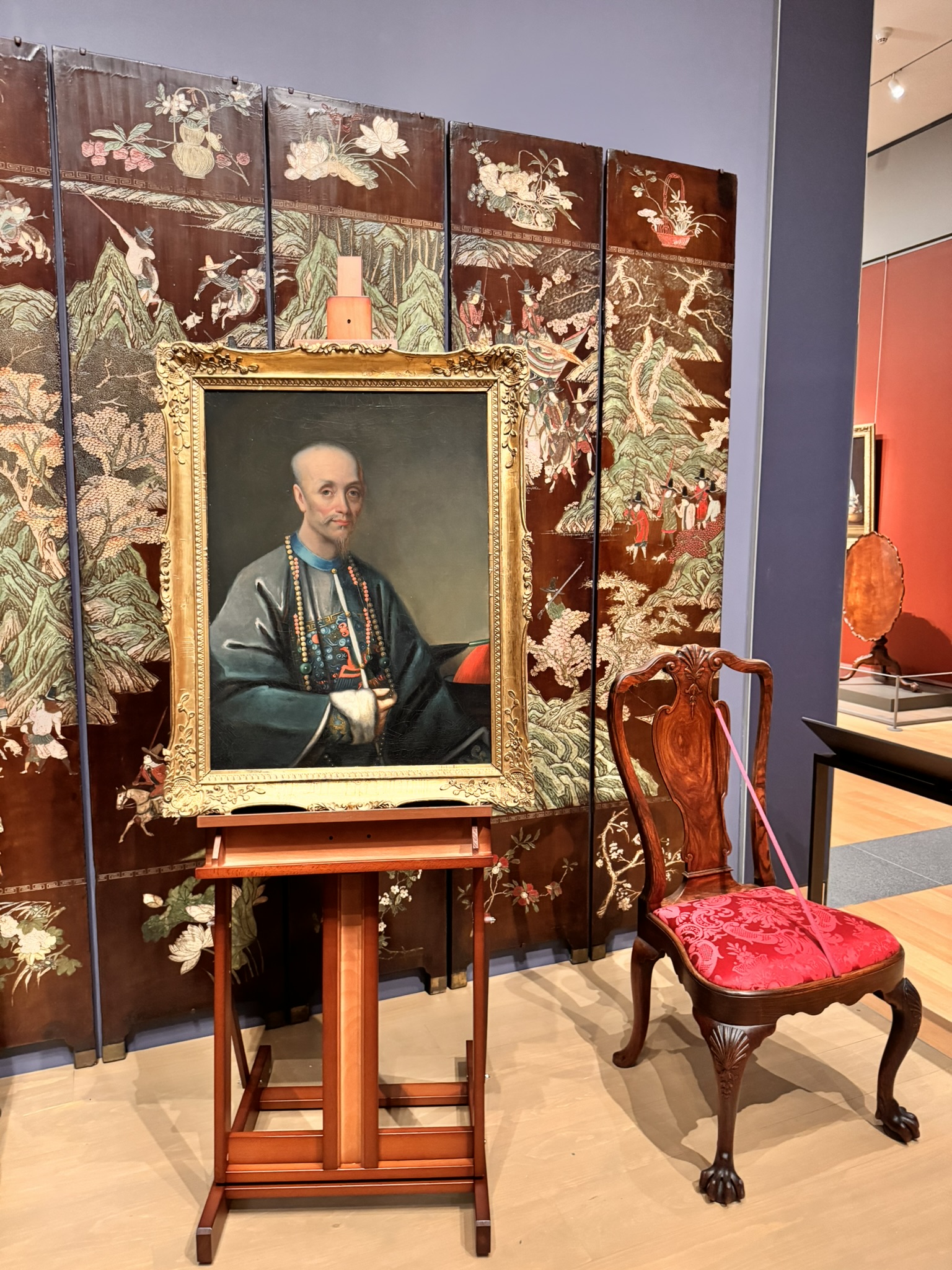
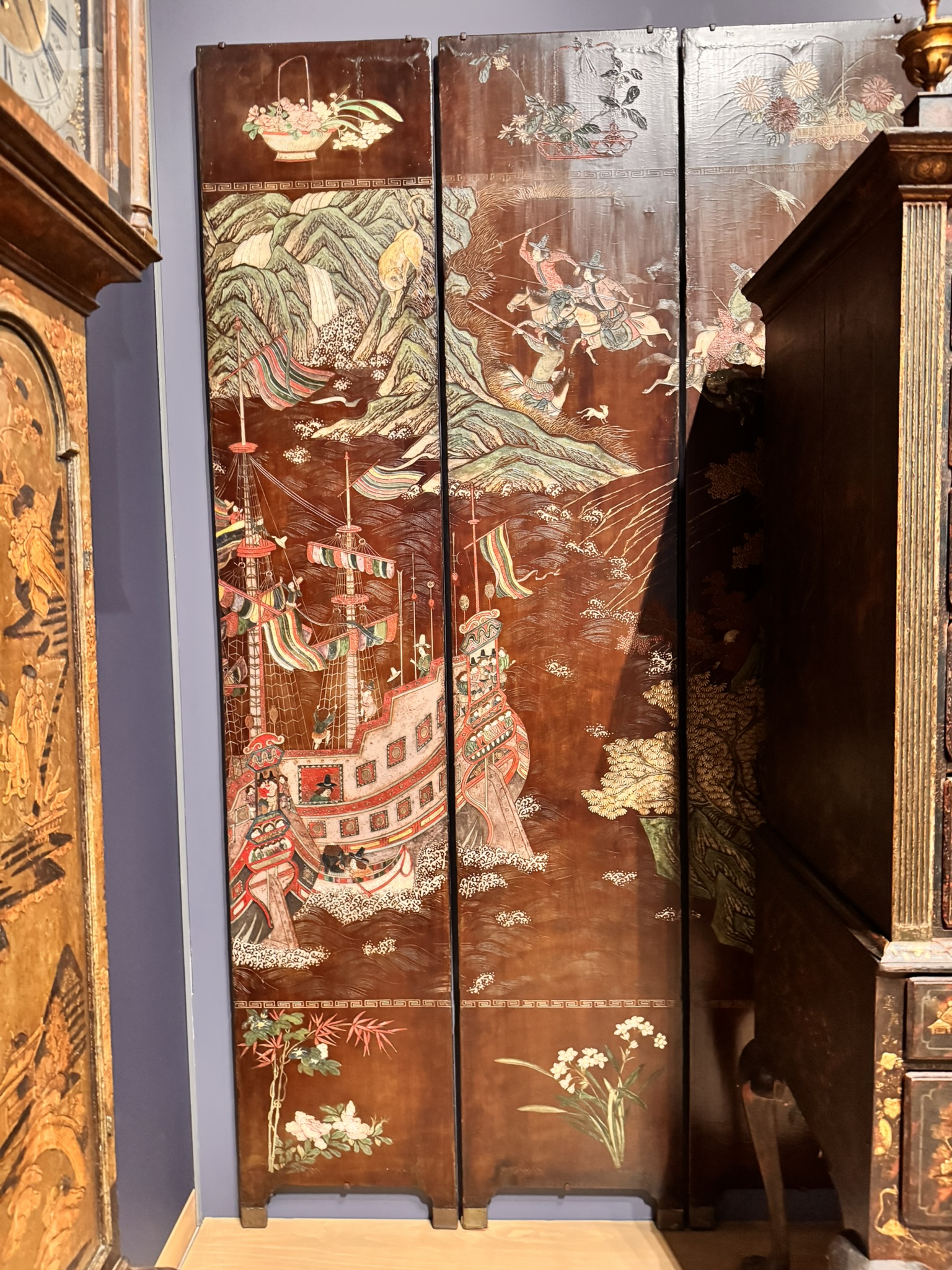
The first (below), a lacquer-on-wood screen made in China around 1700, depicts European visitors with conspicuously light skin and tall hats. They inhabit a landscape of mountains, flowers, trees, and pavilions—the kind of poetic natural imagery I have often noticed in artist Xiang Li’s work.
For centuries, Western artists created generalized fantasies of “the East.” Here, I was seeing the gaze reversed: Chinese artists imagining and stereotyping Europeans. The screen quietly reminded me that whenever one culture represents another, observation and invention are likely to become intertwined.
Chinese lacquer screen, about 1700. European visitors appear amid mountains, flowers, and other elements of a Chinese visual world.
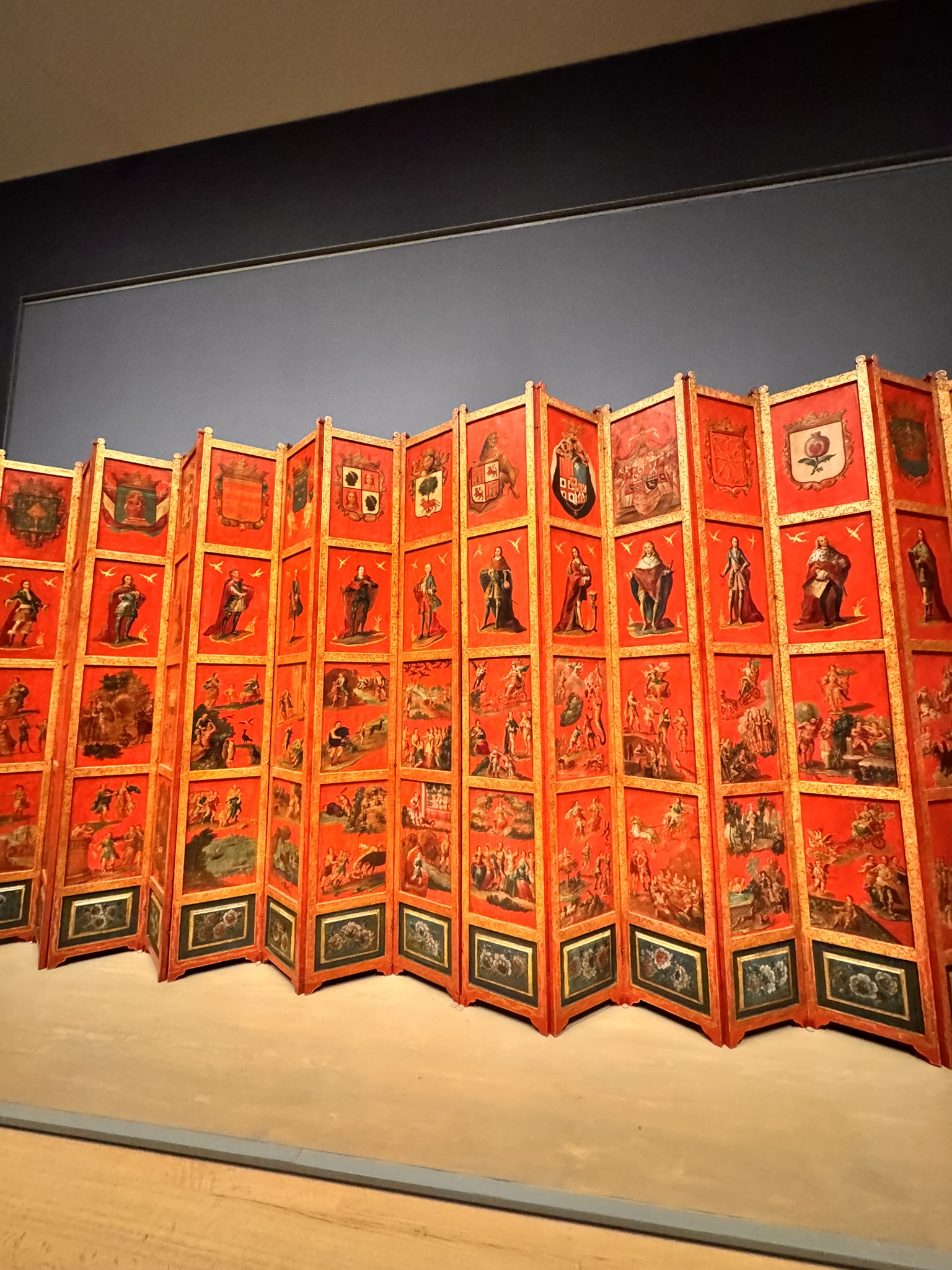
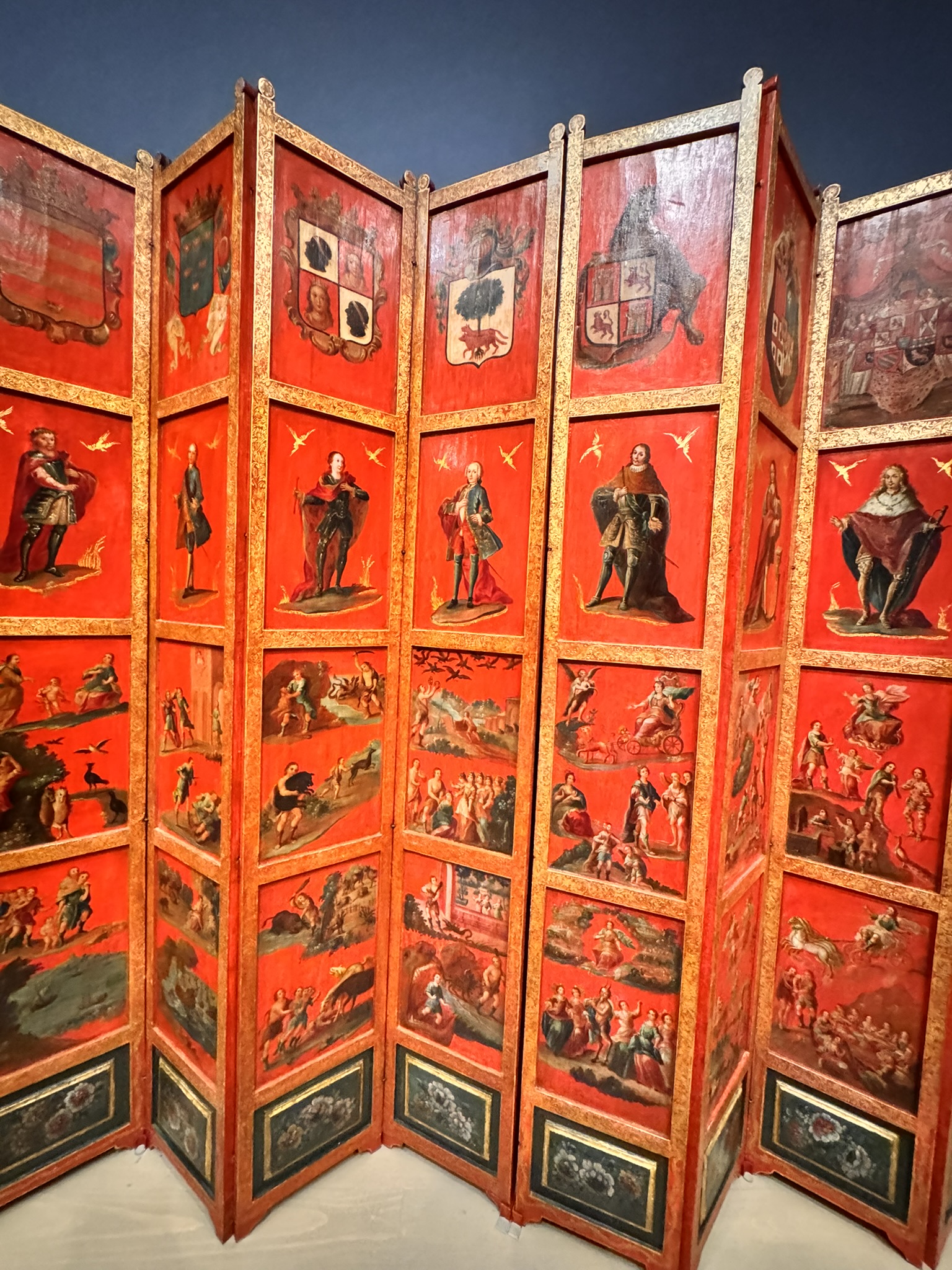
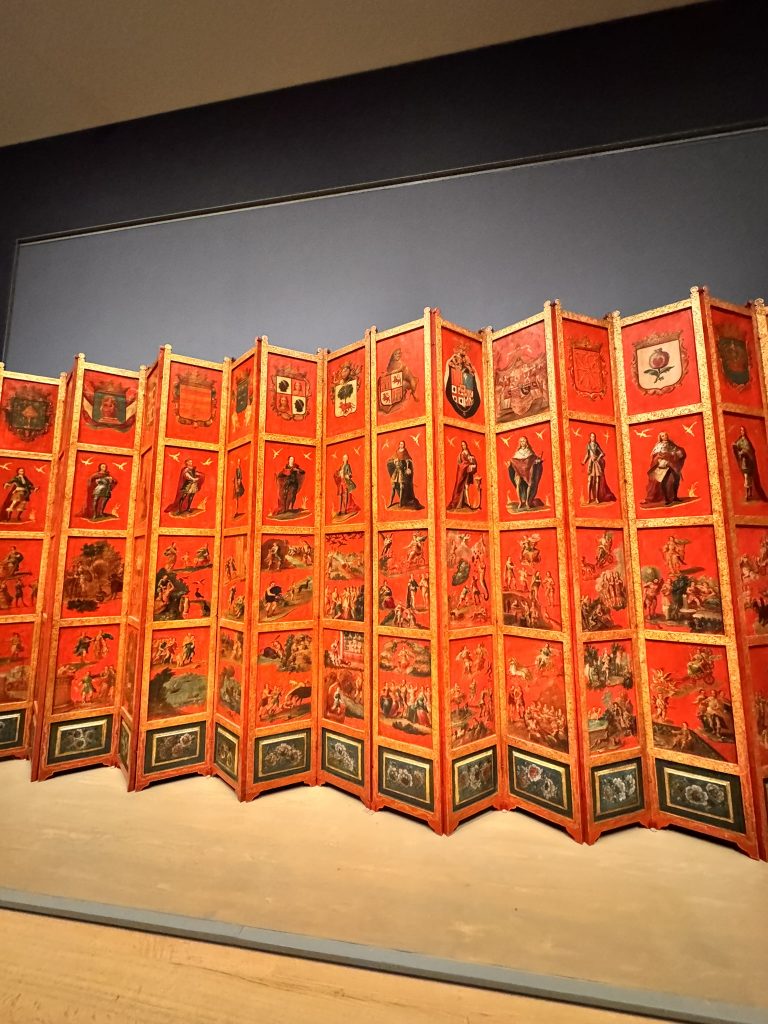
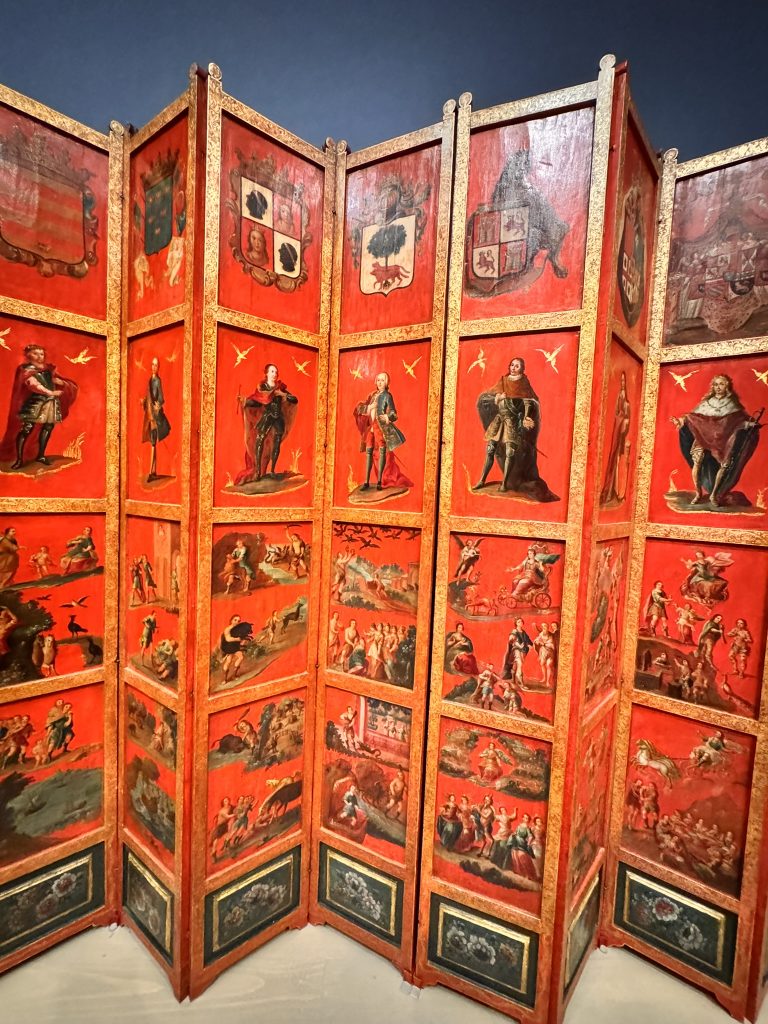
The second screen below was impossible to overlook. Stretching more than fifteen feet and glowing a saturated vermilion red, the double-sided biombo was made in colonial Mexico in the mid-to-late 1700s by artists whose names are no longer known.
Even its name contains a journey. Biombo is a Spanish adaptation of the Japanese word byōbu, meaning folding screen. Its form recalls a Chinese lacquered screen; its imagery draws from European print sources, Spanish heraldry, and scenes from Ovid’s Metamorphoses; and its making reflects both Asian and Indigenous lacquer traditions. Across its 150 painted panels, European figures, heraldic emblems, mythological scenes, chinoiserie landscapes, and delicate flower panels coexist on one theatrical surface.
The biombo felt less like a copy than a new visual language. It could only have emerged from a place where cultures had collided, overlapped, and learned to improvise with one another. That exchange was not necessarily equal or innocent—the screen belongs to a colonial history, and some of its images rely on racial and cultural stereotypes. Yet its very complexity resists the idea that cultures remain pure, sealed, or unchanged by contact.
Chinese lacquer screen, about 1700. European visitors appear amid mountains, flowers, and other elements of a Chinese visual world.
Detail of the Mexican biombo, mid-to-late 1700s. Spanish heraldry and European figures share its glowing red surface with chinoiserie landscapes and flowers
These screens did not merely divide rooms. They opened windows onto the ways one culture imagines another.
When Lacquer Became “Japanning” in Boston
Another concept entirely new to me was “japanning,” the Western imitation of Asian lacquerwork that became fashionable in Europe and the Americas during the seventeenth and eighteenth centuries.
True Asian lacquer was made using resin and highly specialized techniques that Western craftspeople could not easily reproduce. Instead, western artisans layered locally available varnishes, paint, gesso, colored pigments, and metallic powders over wood to approximate the gleam and dimensional decoration of lacquer. They then covered cabinets, chests, and clocks with cranes, flowers, pavilions, mountains, and imagined Asian scenes.
Boston-made ‘japanned’ high chest and tall clock—objects that reveal both the source of inspiration and its local reinvention. About the chest: High chest of drawers made by Robert Davis in colonial Boston between, 1735–39, maple and pine with ‘japanned’ decoration.
The term itself reveals how readily the immense diversity of Asia was simplified into categories. Lacquering traditions existed across several Asian regions, yet Europeans broadly called the imitation “japanning,” just as porcelain from many countries continued to be called “china.”
Most surprising of all was learning that Boston is the only city in the present-day United States known to have produced a significant amount of japanned furniture. The MFA display includes a tall clock and a high chest of drawers made by Robert Davis between 1735 and 1739—two of only about sixty surviving examples from colonial Boston.
Looking closely at the high chest, I could see what the imitation had become in local hands. Raised motifs were built from gesso. Colored varnishes and metal powders added brilliance. Red and black pigments suggested tortoiseshell. The result was inspired by Asia, but it was unmistakably a Boston object: maple and pine transformed by a distant aesthetic desire.
I had encountered Chinese-style furnishings in New England’s historic homes many times. Now I realized that some of what I had been reading as imported “Chinese” beauty may have been Western interpretation—an imagined Asia made in a workshop much closer to home.
The Makers and Artists Who Disappeared Behind the Beauty
One phrase appeared repeatedly in the gallery labels: Artist once known.
I found those three words unexpectedly haunting. They acknowledge that these artists had names, families, workshops, skills, ambitions, and lives—even if history failed to carry their identities forward. The maker has disappeared, while the object remains.
The gallery makes an important distinction: people in the Americas often formed relationships with Asian things without forming relationships with the people who made them. Porcelain, lacquer, silk, and Chinese-inspired furniture signaled refinement, wealth, and knowledge of the wider world. But the individual artisan, often Asian, Indigenous, immigrant, colonized, or otherwise working outside the written record, could vanish behind the glamour of the finished object.
Museums train us to look at what has survived. History asks us to notice who has gone missing.
A Thought to Carry With You
I entered Asian Styles in the Americas expecting to learn how Asian art influenced Western taste. I left with a larger realization: culture does not travel like a sealed package. Every journey brings interpretation, misunderstanding, adaptation, and reinvention.
The ivory Virgin and Child, the Chinese screen, the Mexican biombo, and the Boston-made japanned chest resist simple labels. Their hybridity is not a dilution of something once pure, but a record of how culture has always grown—through encounter, curiosity, friction, and exchange.
The exhibition asks us not only to admire these traveled objects, but to follow their beauty back to the hands and histories that made them possible. Whose knowledge moved? Whose labor disappeared? What changed in the crossing? Art, I realized, carries the imprint of every shore it has touched.
That may be the most mind-opening gift of the gallery. And when we learn to see those crossings, the world no longer looks like a collection of separate cultures. It begins to look like an unfinished conversation.
Asian Styles in the Americasis on view in Gallery 128, the Norma and Roger Alfred Saunders Gallery, in the Art of the Americas Wing at the Museum of Fine Arts, Boston. All photographs in this essay are from my visit on August 20, 2026.
A quiet encounter with a rare portrait, tucked away in Harvard’s Art Study Center, reminded me that sometimes the most powerful art lives just around the corner. Introduction Last year, I crossed the Charles River for what I thought would be a short research trip—but it turned into a very special art experience for me….
During my recent trip to London, I had the chance to visit the renowned Victoria & Albert Museum (V & A Museum), a treasure trove of global art and culture. While wandering through its vast galleries, my friends suggested that we see the South Asian Art section, a space brimming with history, artistry, and narratives…
A Greek Dessert, an Indian Question, and a Silk Road Mystery Introduction A few weeks ago, I picked up several varieties of sesame halva (or halwa) from a local Greek grocery store, Sophia’s Greek Pantry. I had tasted halva before in Middle Eastern restaurants and markets, but this version felt different. It was made primarily…
From Boston to Madrid: A Personal Reflection on Art, Cultural Memory, and How Certain Artists Become Household Names Introduction On my recent trip to Madrid with a group of girlfriends, all of us trained in architecture and design, we had the pleasure of visiting two extraordinary museums: the Prado and the Reina Sofía. Both are…




 Chinese lacquer screen, about 1700. European visitors appear amid mountains, flowers, and other elements of a Chinese visual world.