Mahabharata | Episodes 61 – 68 | The Last Hope for Peace
The Mahabharata is often remembered for its great war, but these chapters tell the story of the final days before it began. As the Pandavas complete their exile, Krishna makes one last appeal for peace, Karna faces an impossible choice between loyalty and blood, and Vidur quietly stands by Dharma. Together, these moments bring the kingdom to the threshold of Kurukshetra.
Note: I decided to publish this installment as a standalone blog post—in addition to its place within my grandmother’s Mahabharata Project—because, to me, these chapters represent the true turning point of the Mahabharata.
The great war does not begin on the battlefield. It begins here: in the final conversations, the failed peace negotiations, the difficult choices, the political maneuvering, and the military preparations that make the Kurukshetra war inevitable.
I’d love to hear your thoughts after you’ve read my reflection at the end of the page. Do you also see these final moments before Kurukshetra as the point where history became impossible to change?
My Grandmother’s Handwritten Memories in Marathi


My Mother’s Translation in English
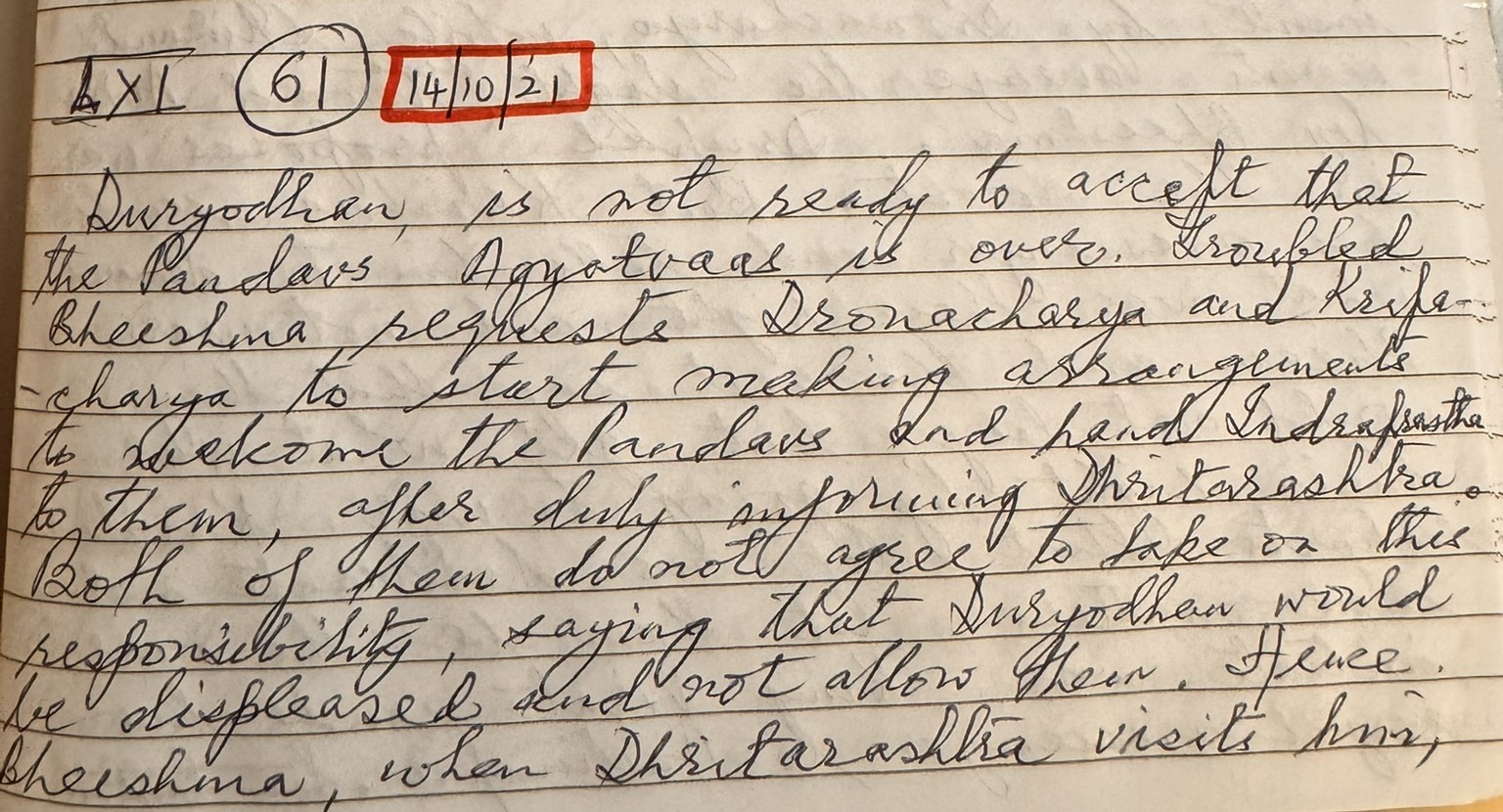
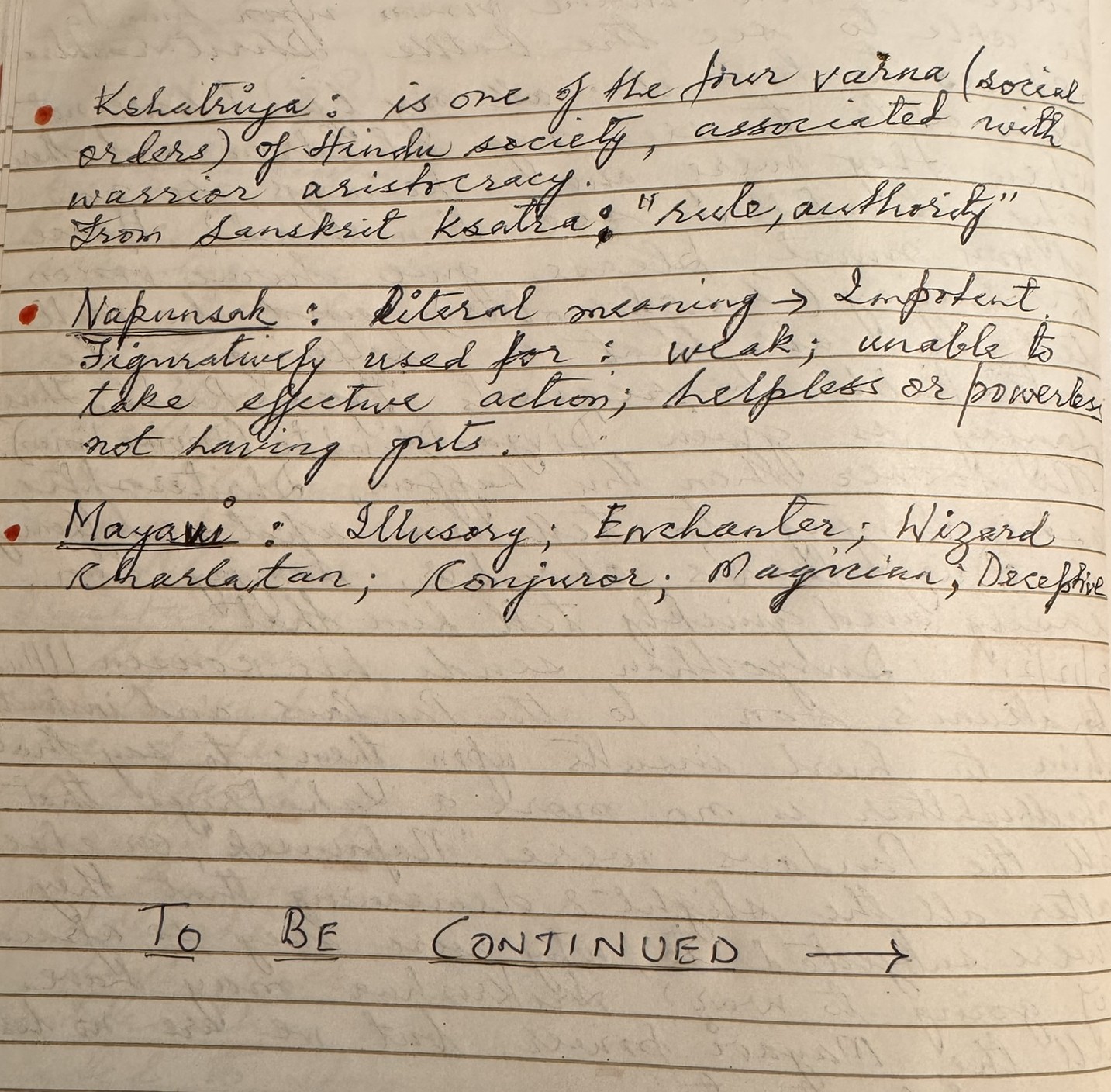
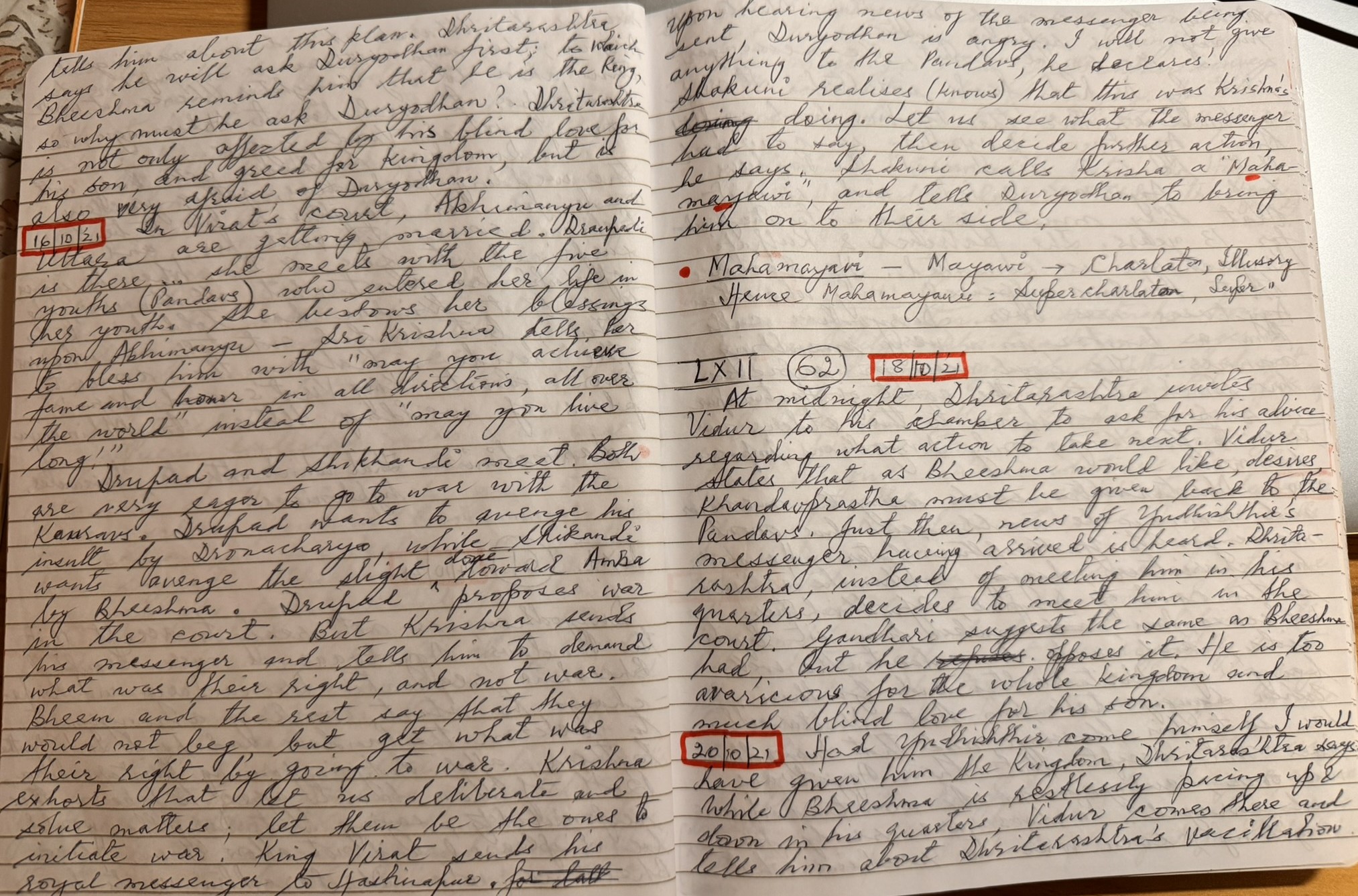
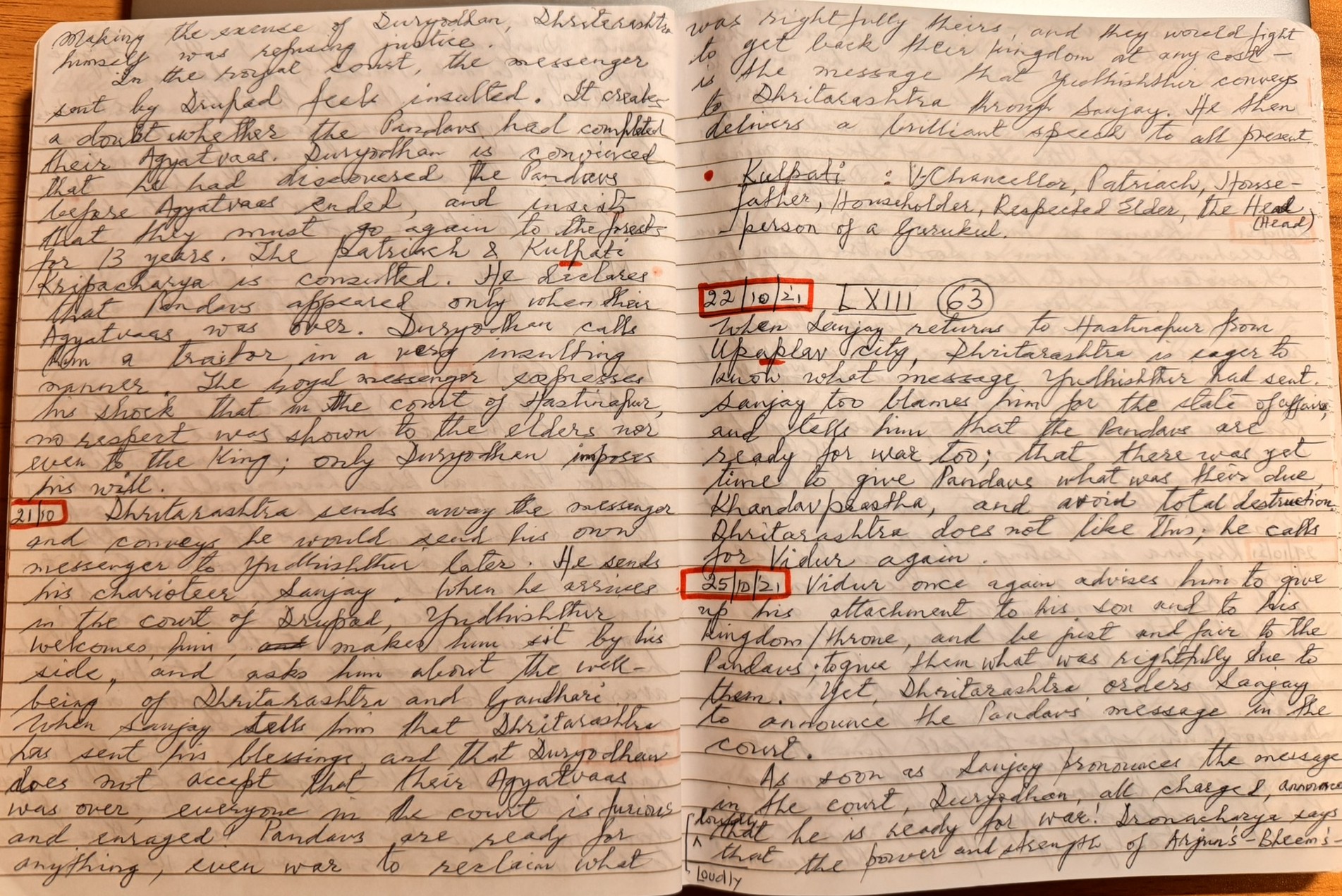
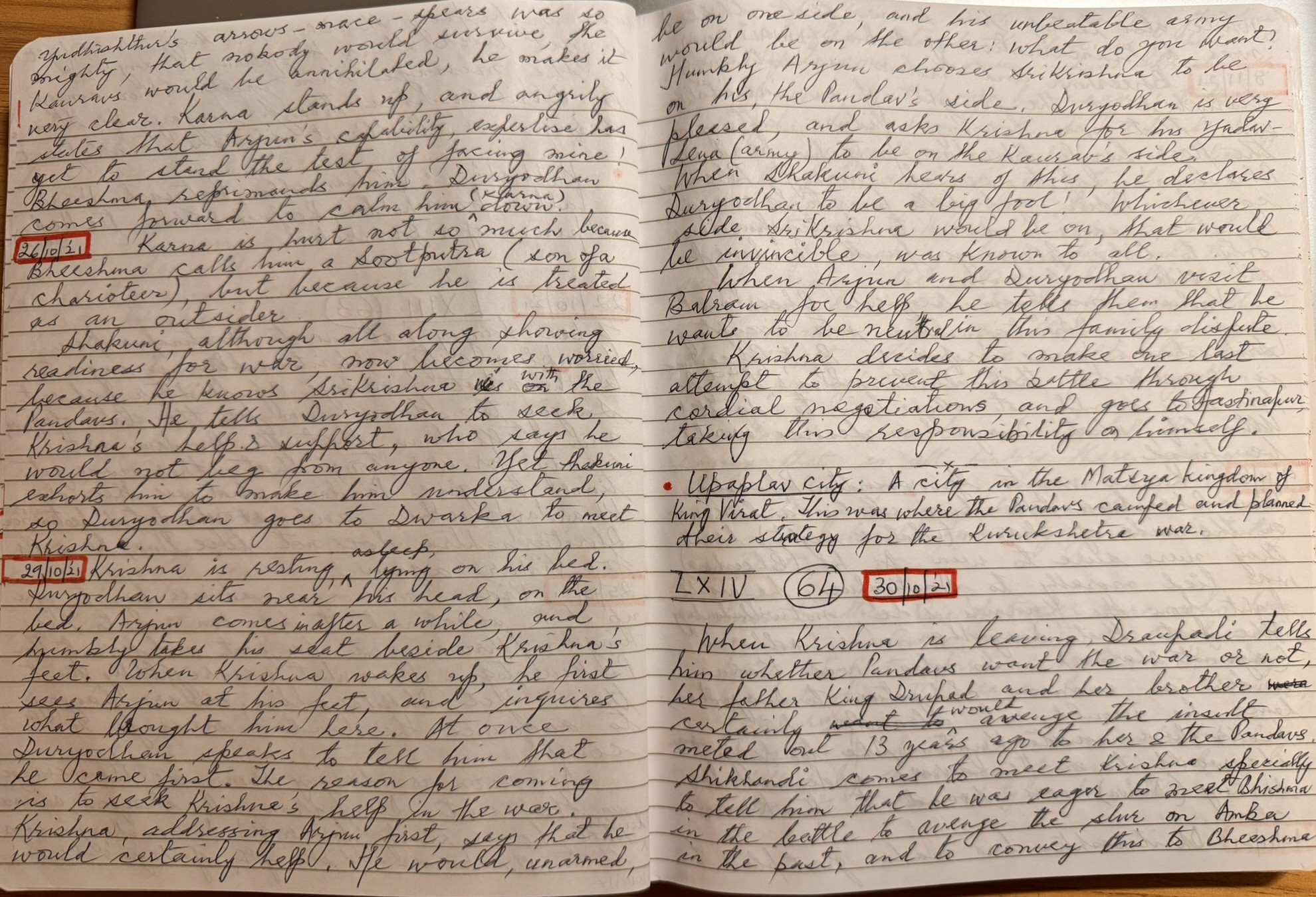
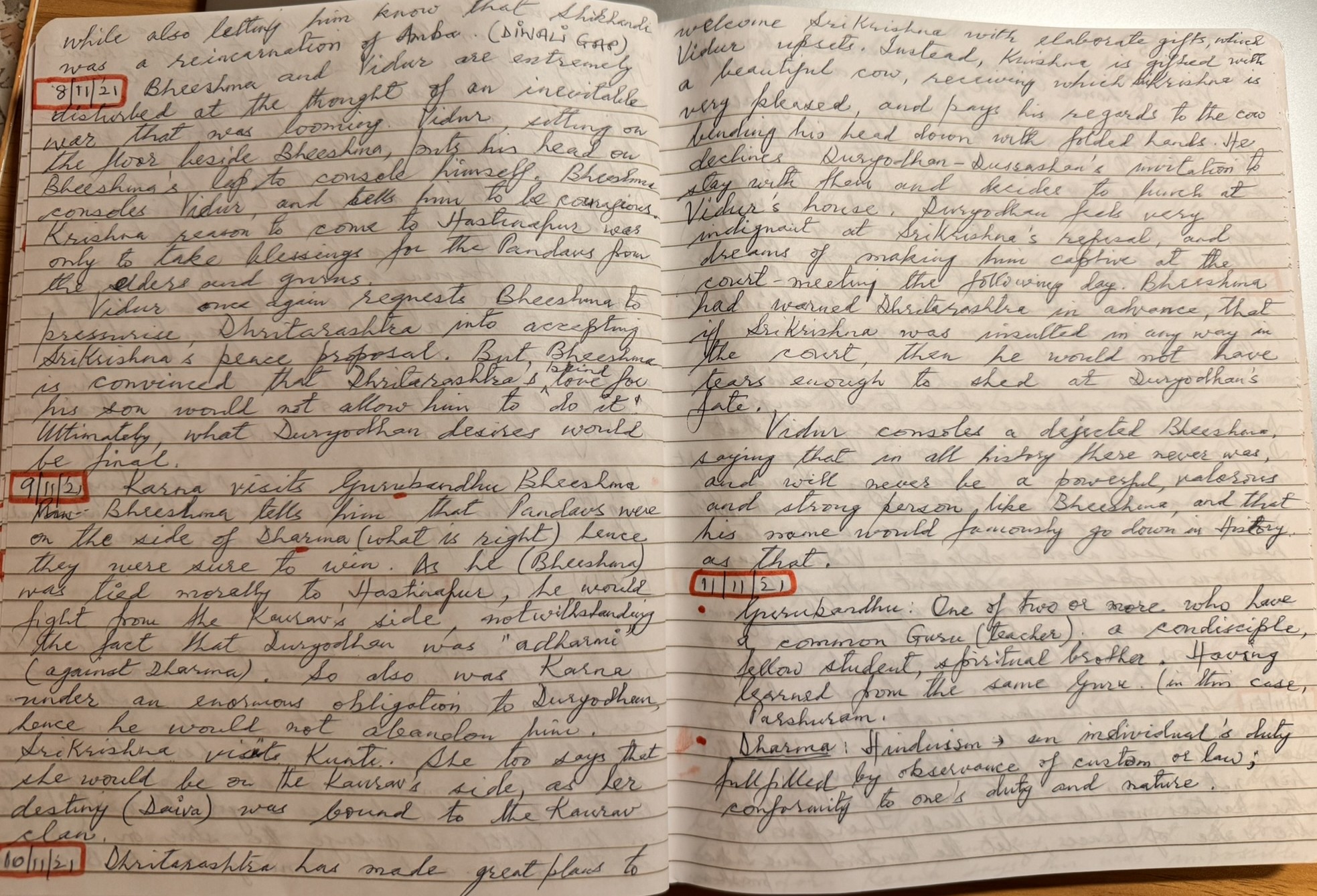
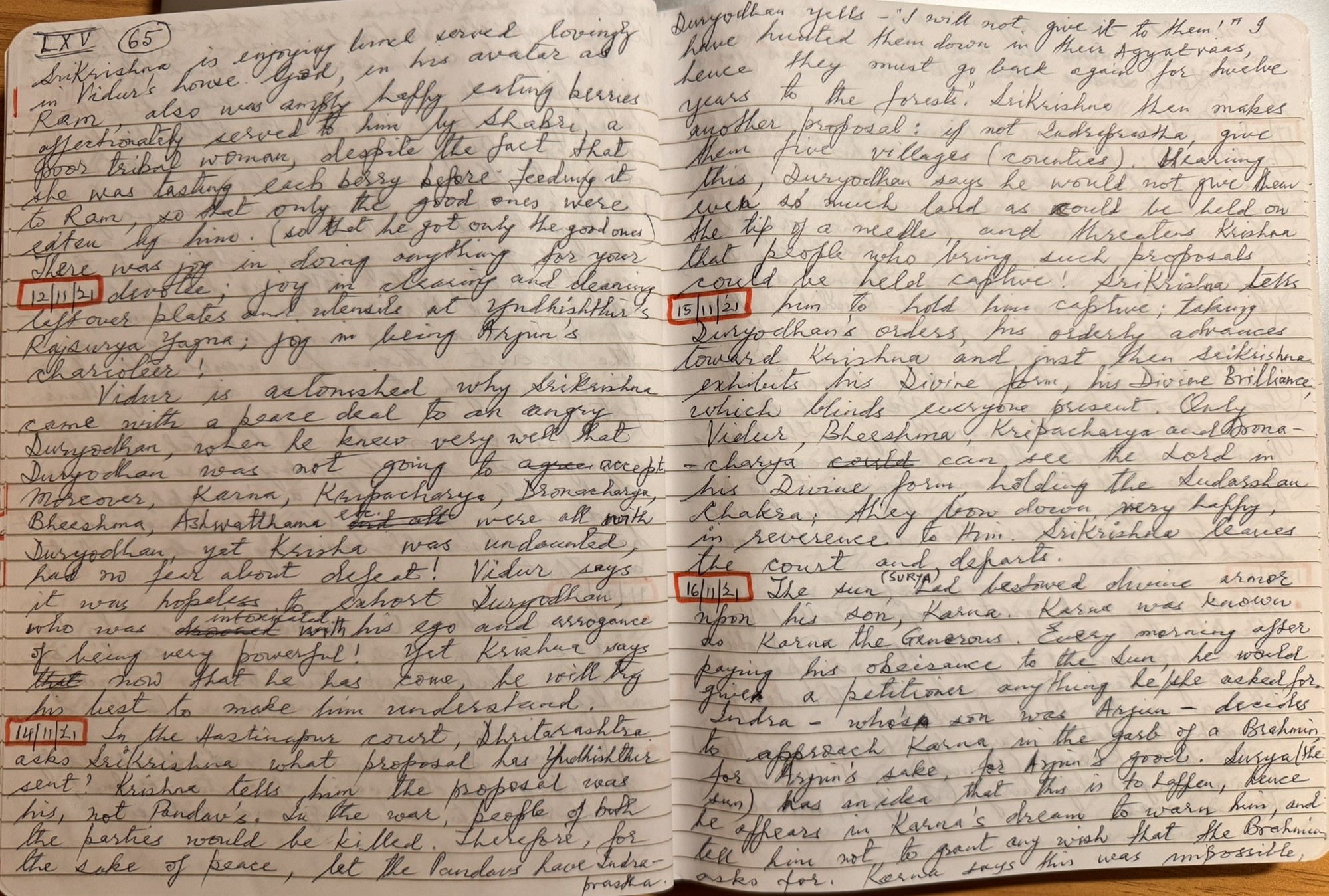
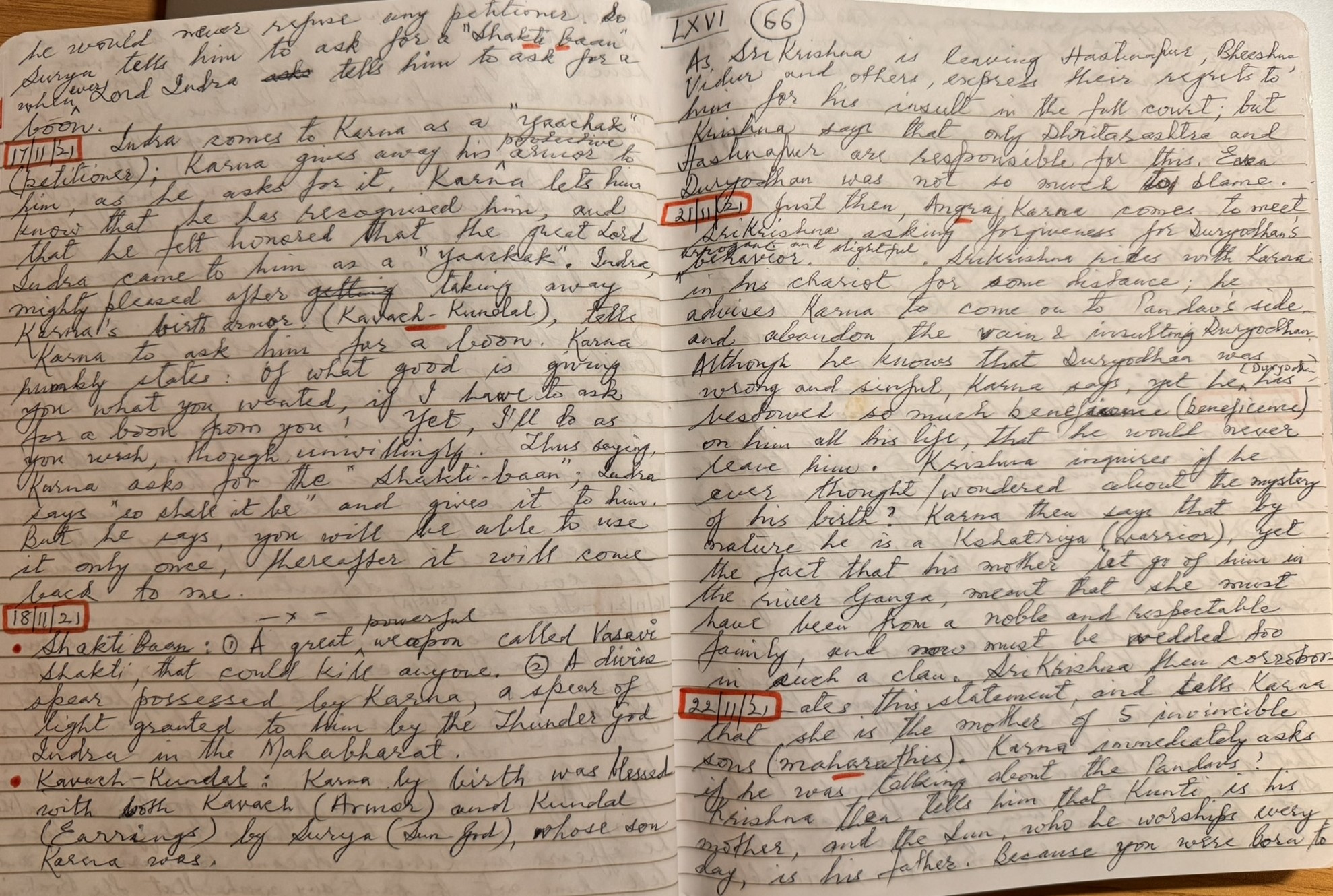
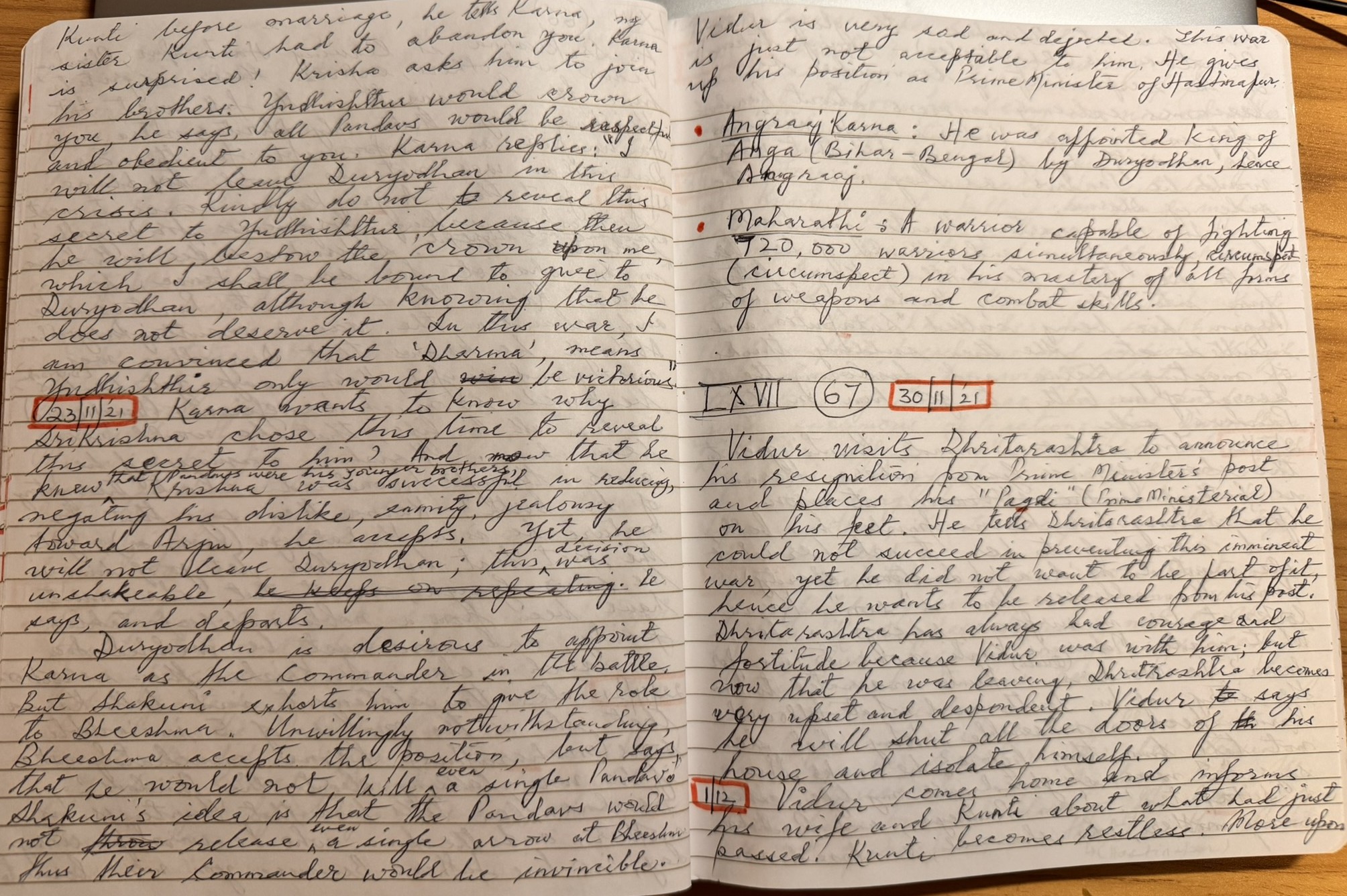
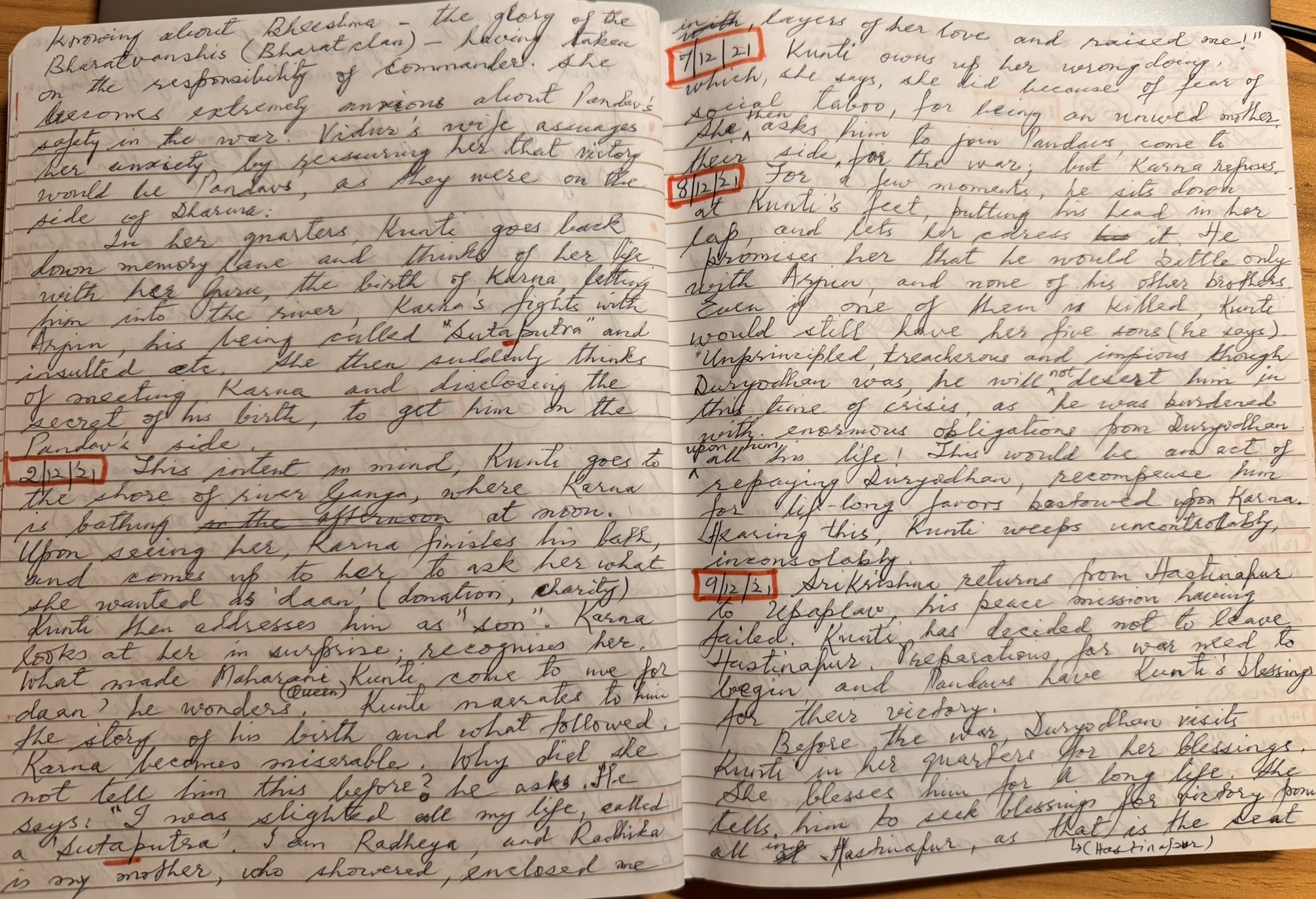
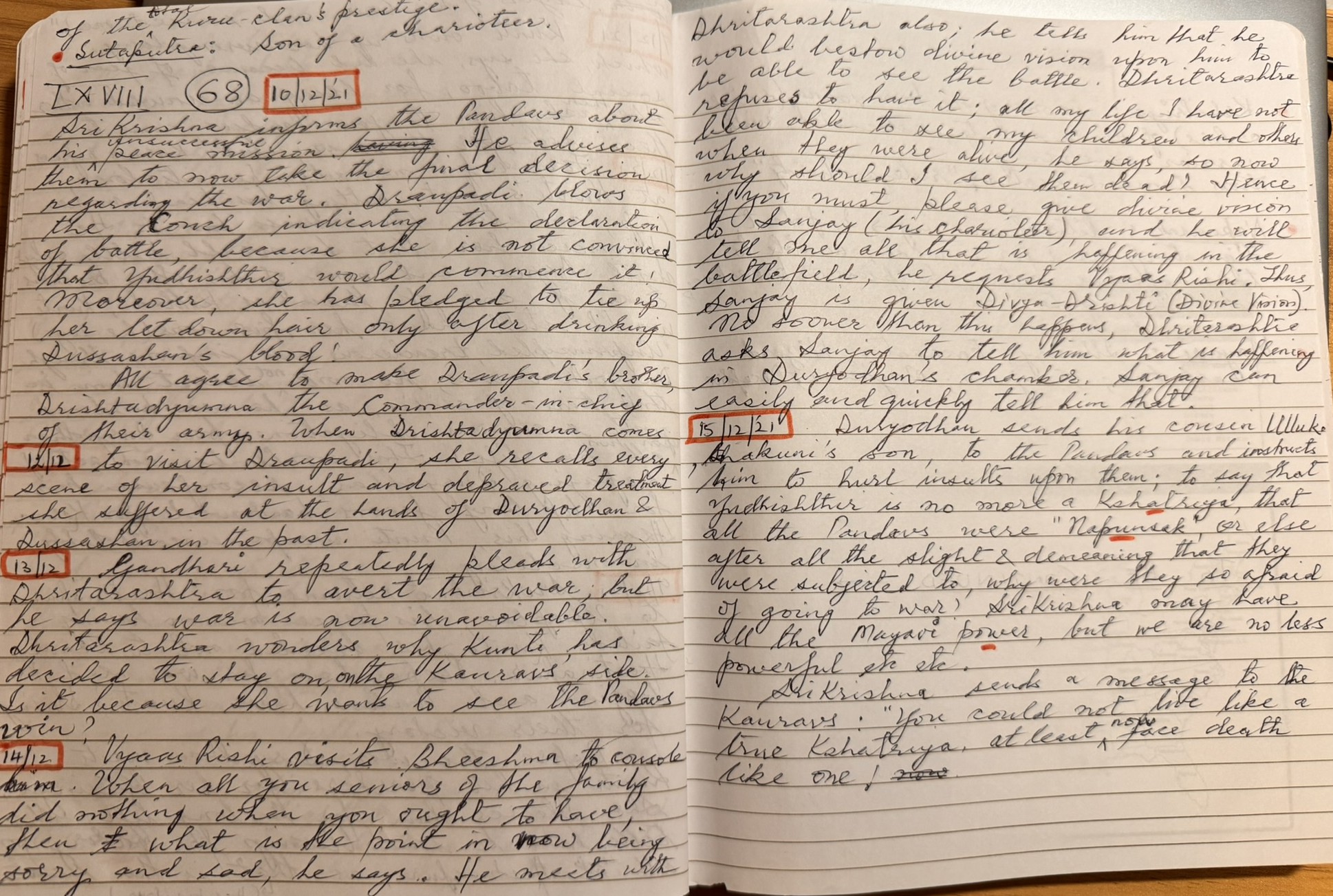
My Digital Version in My Voice – Mahabharata TV Episodes 61-68
Table of Contents

Peace Negotiations
The thirteen long years had finally come to an end.
The Pandavas had fulfilled every condition imposed upon them—twelve years of exile in the forests followed by one year living in complete anonymity. By every measure of law, custom, and Dharma, the kingdom of Indraprastha rightfully belonged to them once again.
Yet everyone in Hastinapur knew that the greatest obstacle was never the passage of time. It was Duryodhan’s pride.
The Pandavas did not gather their armies or march toward Hastinapur in anger. Instead, they first sought justice through dialogue. They asked only for the return of the kingdom that had been promised to them.
Within the royal court, the elders of the Kuru dynasty spoke with one voice. Bhishma, Vidur, Dronacharya, Kripacharya, and even Gandhari urged Dhritarashtra to honor his word. They reminded him that a king’s promise carried the weight of Dharma and that the Pandavas had faithfully fulfilled every condition imposed upon them.
Dhritarashtra knew they were right. Yet, like so many moments throughout the Mahabharata, he found himself caught between righteousness and his overwhelming attachment to Duryodhan. He possessed the wisdom to recognize justice but lacked the courage to uphold it.
Meanwhile, in the kingdom of Virat, life briefly offered a welcome moment of celebration. The marriage of Abhimanyu and Princess Uttara brought together the Pandavas, the Yadavas, and their allies in joyous festivities. But beneath the happiness lingered an unspoken truth. Peace was slowly slipping away.
King Drupad still longed to avenge the humiliation he had suffered at the hands of Dronacharya. Shikhandi patiently awaited the opportunity to confront Bhishma and fulfill Amba’s unfinished destiny.
Across Bharat, the winds of war were beginning to gather.
Krishna’s Peace Mission
Only Krishna refused to give up hope. War, He believed, should never become the first choice. Every avenue toward reconciliation had to be explored before taking up arms.
Messengers travelled repeatedly between Upaplavya and Hastinapur carrying the same simple request. The Pandavas sought nothing more than what was rightfully theirs. Each time, Duryodhan refused.
Finally, Krishna Himself undertook the journey to Hastinapur as the Pandavas’ peace ambassador.
Duryodhan prepared an elaborate welcome befitting the ruler of Dwarka. Lavish gifts, luxurious accommodations, and a grand royal feast awaited Krishna at the palace. Yet Krishna quietly declined. Instead, He chose to stay in the humble home of Vidur.
This has always been one of my favorite moments in the Mahabharata.
One home overflowed with wealth but lacked sincerity. The other possessed very little, yet overflowed with affection, humility, and devotion. Without delivering a sermon, Krishna demonstrated that true hospitality is measured not by riches, but by the love with which it is offered.
The following day, Krishna stood before the assembled court of Hastinapur. His appeal was remarkably simple.
The Pandavas did not seek conquest. They sought justice.
He reminded the gathered kings that the cost of war would not be borne by rulers alone. Countless innocent families would lose fathers, sons, brothers, and husbands. Once war began, victory itself would come at an unimaginable price.
Bhishma supported Him.
Vidur supported Him.
Dronacharya and Kripacharya urged peace.
Even Gandhari pleaded with her son to abandon his pride.
But pride rarely listens to wisdom.
Duryodhan’s reply has echoed through history:
“I will not give the Pandavas land equal even to the tip of a needle.”
With those words, the final opportunity for peace quietly disappeared. Blinded by arrogance, Duryodhan went one step further. He ordered that Krishna Himself be imprisoned.
Instead, Krishna revealed His Vishvarupa—His infinite cosmic form. The entire universe appeared within Him.
Gods, sages, stars, worlds, creation, destruction, and time itself became visible in a single breathtaking vision. The great warriors stood speechless.
For one brief moment, the blind Dhritarashtra was granted divine sight so that he too could witness the Lord’s cosmic form. Having seen it, he requested that his blindness be restored, saying there was nothing else left in the world worth seeing after beholding the Supreme Being.
Krishna had fulfilled His duty. He had offered every opportunity for peace. The responsibility for what followed no longer rested with Him.
Karna’s Choice: Between Loyalty and Blood
As Krishna departed Hastinapur, He sought out Karna for one final conversation.
Away from the noise of the royal court and the growing preparations for war, Krishna revealed a truth that had remained hidden since Karna’s birth.
He was not the son of a charioteer.
He was Kunti’s firstborn son.
The eldest of the Pandavas.
Krishna offered him everything he had unknowingly lost—his true family, his rightful place among his brothers, and even the throne of Hastinapur.
Yet Karna declined.
Not because he doubted Krishna.
Not because he desired power.
But because gratitude meant more to him than a crown.
When the world mocked him for his birth, Duryodhan alone had treated him with dignity and friendship. Karna believed abandoning that friendship would make him unworthy of the honor he had spent his life trying to earn.
Soon afterward, Kunti herself sought out her long-lost son. She found him at sunrise on the banks of the Ganga, offering his daily prayers to Surya, the Sun God. With tears in her eyes, she confessed the truth she had hidden for so many years and begged him to return to his brothers.
Karna listened quietly. He neither condemned his mother nor accepted her request.
Instead, he gave her a promise that only deepened the sadness of their meeting. He would not raise his hand against any of the Pandavas except Arjun. Then he spoke words that have echoed across the centuries:
“Either Arjun will kill me, or I will kill Arjun. In either case, Mother, you will still have five sons.”
It is difficult not to feel compassion for Karna. He finally discovered where he truly belonged, yet chose to remain where he believed his duty lay. Between blood and loyalty, he chose loyalty.
It was a choice that would shape not only his own destiny, but the fate of the entire Kurukshetra War.
The Commanders Are Appointed
Krishna returned to Upaplavya carrying the news everyone had feared. His peace mission had failed.
The final opportunity to avoid war had slipped away, and both the Pandavas and the Kauravas now began preparing for the inevitable.
For Draupadi, the memories of the royal court at Hastinapur came rushing back. Thirteen years had passed since she had been humiliated before the assembled kings, yet the pain had never left her. She reminded her husbands of the vow they had taken and of the justice that still remained unfulfilled.
The time for diplomacy was over.
The time for preparation had begun.
Both sides now faced the enormous task of organizing armies unlike anything Bharat had ever witnessed.
The Pandavas appointed Dhrishtadyumna, the son of King Drupad, as the Commander-in-Chief of their forces. Born from the sacrificial fire with the destiny of defeating Dronacharya, he possessed both military skill and the confidence of the allied kings.
On the Kaurava side, Duryodhan naturally wished to appoint Karna as commander. Yet Shakuni advised against it. Many of the assembled kings admired Bhishma’s legendary reputation and would fight more confidently under his leadership than under Karna’s. Reluctantly, Bhishma accepted the responsibility. He knew that war had become unavoidable, yet his heart remained heavy.
Before taking command, Bhishma openly declared that although he would fight for Hastinapur because of the oath he had taken decades earlier, he would never willingly kill any of the Pandavas.
His words reflected the painful conflict that had followed him throughout his life. Bound by his vow, yet unable to silence his conscience.
Karna, in turn, refused to fight while Bhishma commanded the Kaurava army. Their disagreements had long been public, and Karna believed Bhishma had never fully accepted him because of his uncertain birth. Rather than create division within the Kaurava camp, Karna stepped aside and promised to enter the battlefield only after Bhishma’s command had ended.
Across the kingdom, great kings, mighty warriors, and ancient allies began choosing sides. Some joined the Pandavas because they believed they stood for Dharma. Others stood beside Duryodhan because of friendship, political alliances, family obligations, or promises made long ago.
Soon, eighteen mighty Akshauhinis of soldiers stood assembled. Never before had Bharat witnessed an army of such extraordinary size.
An Akshauhini is a massive, ancient Indian military battle formation described in the Hindu epic, the Mahabharata. It consisted of a highly specific ratio of chariots, elephants, cavalry, and infantry, totaling 218,700 combatants.
The Final Political Decisions
Even as armies gathered on the plains of Kurukshetra, the final political decisions continued to unfold within the palace at Hastinapur.
For years, Vidur had served as the kingdom’s wisest advisor. Again and again he had urged Dhritarashtra to choose justice over attachment and Dharma over ambition. His counsel had gone unheard.
Realizing that he could no longer prevent the kingdom from walking toward destruction, Vidur made a remarkable decision. He resigned from his position as Prime Minister. Rather than remain in office and silently witness a war he believed to be unjust, he chose to step away.
It was not a dramatic gesture.
There were no armies watching.
No grand speeches.
Only one man quietly refusing to compromise his conscience.
Dhritarashtra was deeply saddened by Vidur’s departure, for he knew he had lost the one advisor who had never spoken to please him, but only to guide him toward righteousness.
Around the same time, Sage Vyasa visited the palace. Knowing that the greatest war in history was about to begin, he offered Dhritarashtra divine sight so that he might witness the events of Kurukshetra with his own eyes.
The blind king gently declined saying “I have never seen my sons while they lived,” he said. “I do not wish to see them lying dead upon the battlefield.”
Instead, he requested that the blessing be granted to Sanjaya (his royal advisor and charioteer). Vyasa bestowed upon Sanjaya Divya Drishti, the gift of divine vision. From afar, Sanjaya would witness every conversation, every battle, and every turning point of the great war, faithfully narrating them to Dhritarashtra as they unfolded.
Meanwhile, Kunti made a difficult decision of her own. Though her five sons were preparing for war, she chose to remain in Hastinapur. Having only recently revealed the truth of Karna’s birth, she now carried a burden that no mother should ever have to bear—the knowledge that her sons would soon stand on opposite sides of the battlefield.
The War Becomes Inevitable
With diplomacy exhausted and preparations complete, even words became weapons.
Duryodhan sent his maternal cousin Uluka to the Pandava camp carrying one final message.
It was not an appeal for peace.
It was a deliberate provocation.
Uluka mocked the Pandavas for their years of exile, questioned their courage, and challenged them to prove themselves on the battlefield. His message was designed to inflame old wounds and ensure that no possibility of reconciliation remained.
The Pandavas listened calmly.
Krishna’s reply was measured and unwavering.
A true Kshatriya, He reminded them, does not boast before a battle. He demonstrates his courage through his actions.
The time for arguments had passed.
Now each side would have to stand by the choices it had made.
Every effort to preserve peace had been exhausted.
The commanders had been chosen.
The alliances had been formed.
The armies stood assembled across the sacred plains of Kurukshetra.
The fate of Bharat would soon be decided—not by words spoken in royal courts, but by the actions of those who had chosen their path.
An uneasy silence settled over the land. The conches had not yet sounded. But everyone knew they soon would.
Reflections
One of the reasons I find these chapters so compelling is that almost every major character knows what the right course of action is.
Bhishma knows.
Gandhari knows.
Dronacharya knows.
Krishna certainly knows.
Even Dhritarashtra knows.
Yet knowing what is right is not always enough.
Bhishma is bound by the oath he made in his youth.
Dronacharya is bound by gratitude to the throne of Hastinapur.
Karna is bound by loyalty to the friend who gave him dignity when the world denied it.
Dhritarashtra is bound by his attachment to his son.
Each is imprisoned by a different obligation.
Vidur, however, stands apart.
Unlike the others, he refuses to compromise his conscience. Again and again, he advises Dhritarashtra to choose Dharma over attachment and justice over ambition. When he realizes that his counsel will no longer change the course of events, he quietly lays down the office of Prime Minister. He gives up power rather than lend his name to a cause he knows is unjust.
I find something profoundly moving about that decision from Vidur when all the other elders decided to stick with the Kauravas for the sake of Hastinapur.
This decision isn’t accompanied by divine miracles or stirring speeches. It doesn’t unfold on a battlefield. There are no cheering crowds to witness it.
It is simply one man quietly choosing not to compromise his conscience.
Sometimes, those are the bravest decisions of all.
As I reflected on these chapters, I found myself returning to Vidur again and again. His decision doesn’t receive the same attention as Krishna’s Vishvarupa or Karna’s heartbreaking choice, yet I wonder if it is one of the most powerful lessons in this part of the Mahabharata. We often admire people who speak wisely. But wisdom has little value unless it is accompanied by the courage to act upon it.
Vidur reminds us that Dharma is not merely knowing the right path—it is having the integrity to follow it, even when it costs us our position, our influence, or our comfort.
Karna, on the other hand, presents us with a very different moral dilemma. When Krishna reveals the truth of his birth, Karna is offered everything he had unknowingly lost—his true family, his rightful place among the Pandavas, and even the throne of Hastinapur.
Yet he walks away.
Not because he doubts Krishna.
Not because he desires power.
But because he believes abandoning Duryodhan would betray the friendship that first gave him dignity.
Whether we agree with his decision or not, it is impossible not to understand the conflict within him. Perhaps that is why these chapters continue to resonate with me.
The Mahabharata is not simply preparing us for the great war at Kurukshetra. It is asking each of us a quieter question.
When we know what is right, will we find the courage to act on it?
Bhishma knew.
Dronacharya knew.
Gandhari knew.
Even Dhritarashtra knew.
Vidur did more than know. He acted.
And perhaps that is why, among all the kings, warriors, and princes in these chapters, it is Vidur’s quiet departure from the palace that stays with me long after I have finished reading them.
The Mahabharata is often described as the story of a great war.
But these chapters remind me that wars begin much earlier. They begin when pride silences wisdom, when attachment overcomes justice, and when people fail to act upon the truth they already know.
By the time the first conch is blown at Kurukshetra, the battle has already been fought many times over—in the hearts of those who still had the power to prevent it.
-> Continue reading the story of Mahabharata through my grandmother’s journal here.


