My Grandmother’s Mahabharata: A Letter to the Next Generation
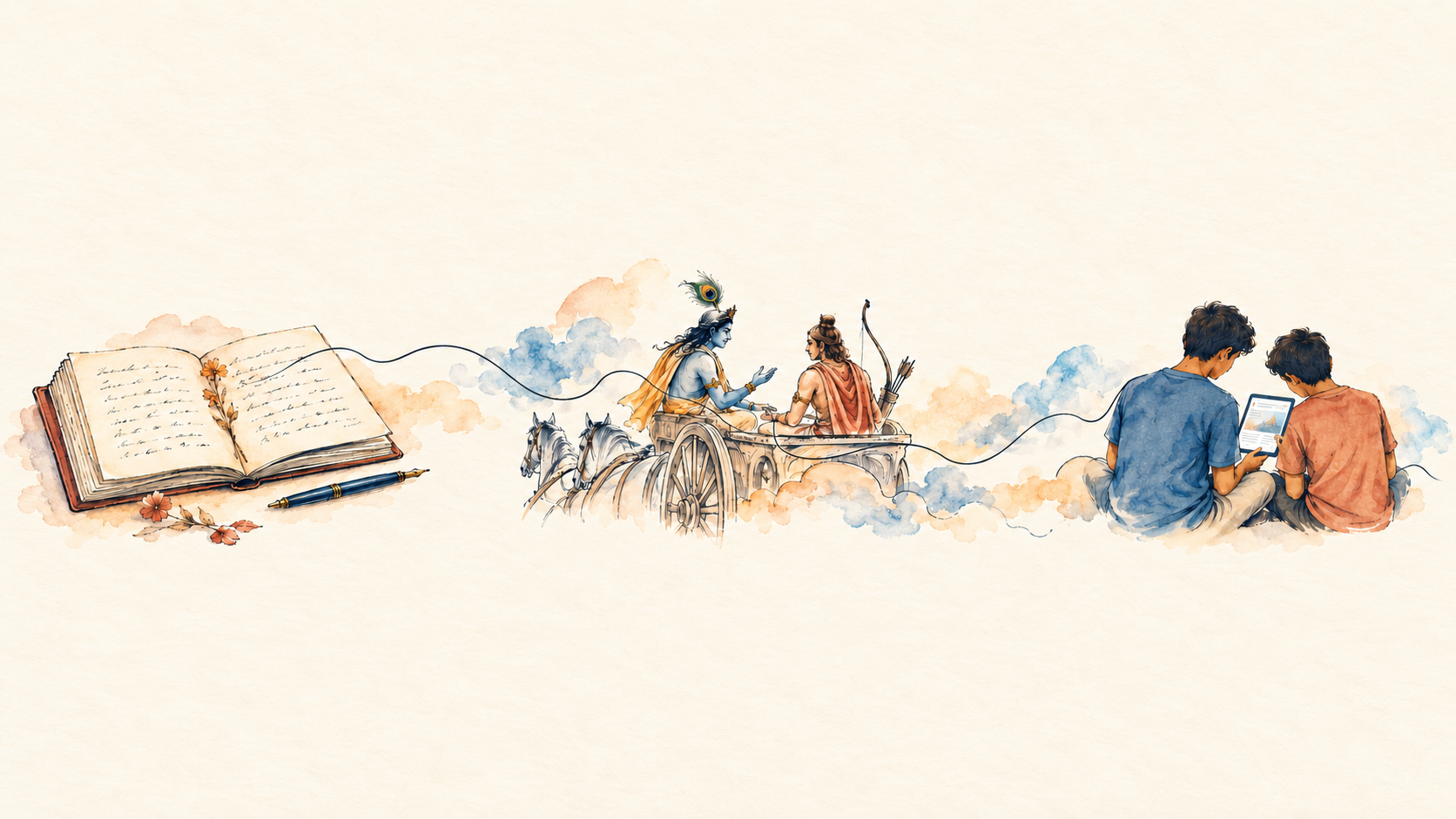
For my sons, and for anyone growing up between cultures—with questions about belonging, courage, heritage, and the person they want to become.
Before this story became a page you could open on your phone, it lived in your great-grandmother’s handwriting. My grandmother, Malti Harshey, recorded the Mahabharata in Marathi as she watched it unfold on Indian television. After her death, my mother, Mohini Harshey—your grandmother—preserved the journal and eventually translated it into English, completing that work in 2023. I have now finished retelling all 93 episodes documented in that journal on my blog, shaping the narrative in my own voice with the help of ChatGPT and adding my reflections along the way. Three generations of women have carried this story forward. I wanted you to have a way into it.
Finishing gives me a quiet sense of accomplishment. Something that could have remained tucked away in a family notebook is now accessible to you, our extended family, and anyone curious enough to read it. But my thinking about the story is still changing. As I worked, I found myself questioning characters I had admired, understanding characters I had judged, and discovering parts of the ending I barely knew. I began by preserving something my grandmother had left behind. Along the way, I found that she still had things to teach me.

You have grown up and gone to school here in the United States, with Indian roots but fewer opportunities to encounter the ancient Indian stories that were part of my childhood. Perhaps you know the names Krishna and Arjun without quite knowing their story. Perhaps the Mahabharata feels like something older relatives understand and you were somehow expected to absorb. I wanted to give you a way to explore that part of your heritage, in language that connects with your own lives.
You can begin here, with no background knowledge at all.
The Mahabharata and the Bhagavad Gita are sacred to the Indian civilization. Across generations, their stories and ideas have shaped literature, art, philosophy, and conversations about how to live. Exploring them is one way to understand the civilization from which our family comes—and the questions about duty, justice, and human nature that people have wrestled with for centuries. You can bring your own experiences and questions to that conversation.
And the human questions inside it may feel surprisingly familiar. What would you do to fit in? When should you stand up to a friend? How do you handle someone else’s success? What happens when winning costs more than you expected?
First, the story in two minutes
The Mahabharata is an ancient Indian epic traditionally attributed to the sage Vyasa. At its center are two branches of one royal family: the five Pandava brothers and their cousins, the Kauravas, led by Duryodhan. They grow up in the same world, but rivalry over power and inheritance becomes increasingly bitter.
The Pandavas survive attempts to destroy them and build a flourishing kingdom. Then a disastrous game of dice changes everything. Yudhishthir, their eldest brother, gambles away what he has, stakes people he has no moral right to treat as possessions, and helps bring his family to ruin. Draupadi, wife to the five brothers, is publicly humiliated in a royal court where powerful people fail to protect her. The Pandavas eventually spend thirteen years in exile, the last in disguise.
When they return, efforts to negotiate peace fail. Two great armies gather at Kurukshetra. Just before battle, Arjun looks across the field and sees relatives, teachers, and people he loves. He cannot bring himself to fight. His conversation with Krishna becomes the Bhagavad Gita, a sacred dialogue within the larger epic.
The war lasts eighteen days. The Pandavas win, but the losses are devastating. My grandmother’s retelling closes with grief, moral reckoning, and hope for another generation through the child Parikshit. The full Sanskrit epic extends beyond the events covered in this 93-episode project.
A few people to know
You do not need to memorize a family tree in the story. Start with these relationships and questions.

A word that runs through everything is dharma. It carries meanings including duty, righteousness, and the order that sustains life. For this introduction, think of it as the demanding question: What does doing right require of me here? The difficulty is that our responsibilities—to family, friends, truth, and other people—can pull in different directions.
1. Karna: belonging should leave room for your conscience
Karna knows the pain of being judged by where he comes from. When others dismiss him, Duryodhan recognizes his ability and gives him status. That acceptance matters deeply. Even after learning that the Pandavas are his brothers, Karna remains loyal to the friend who stood beside him.
I understand why. When someone makes you feel that you belong, gratitude can become part of your identity. But in my reflections on Karna, I kept returning to a difficult question: what happens when the person who supported you also harms others?
Imagine that the friend who welcomed you into a new school starts humiliating another student. You remember how kind they were to you. Challenging them feels disloyal. Yet their kindness to you does not cancel their cruelty to someone else.
Karna’s wounds deserve compassion. His choices still deserve examination. You can care about a friend, appreciate what they have done for you, and refuse to join in something wrong. A friendship worth having should have space for an honest objection.
Read more: Episodes 88–91.
2. Draupadi: the person being humiliated may be the clearest thinker in the room
During the dice game, Yudhishthir loses himself before staking Draupadi. Brought before the court, she challenges the legitimacy of what has happened: how could someone who had already lost his own freedom have the right to stake her?
What struck me was her intellectual courage. Surrounded by people with more institutional power, she makes them confront the question they would rather avoid. The elders’ learning and authority offer little protection when they fail to act.
A school group chat is a very different setting, but it can expose a similar failure of responsibility. Someone becomes the target. A private photo is shared, a cruel joke gathers reactions, or a rumor becomes entertainment. Many people know it is wrong. They wait for someone else to say so.
You do not need a perfect speech. Refuse to forward it. Say that it crosses a line. Check on the person being targeted and get help from a trusted adult when needed. What matters is that your awareness becomes some form of support.
Draupadi also reminds me to listen to the person experiencing harm. She has an argument, a voice, and a claim to justice. She is much more than someone waiting to be rescued.
Read more: Episodes 46–50.
3. Duryodhan and Yudhishthir: notice the small choices before they become a crisis
Duryodhan cannot enjoy his position because the Pandavas’ prosperity feels unbearable. Shakuni, his uncle, knows how to encourage that resentment. Meanwhile, Yudhishthir’s reputation for righteousness does not prevent him from making disastrous decisions at the gambling table.
In my reflections, I noticed how much destruction begins before anyone draws a weapon. There is an injured ego, an excuse, a warning brushed aside, another decision made to recover from the last one.
You may recognize the smaller version: a friend’s college acceptance makes your own plans feel inadequate; someone else earns the starting position and suddenly your progress seems worthless. Or you keep going with a bad decision because admitting the mistake now feels embarrassing.
Feeling jealous does not make you Duryodhan. The important moment is what you do with that feeling. You can notice it without feeding it. And being known as a good person does not make you immune to a bad decision. Learn to pause while the consequences are still small.
Read more: Episodes 41–45.
4. Arjun and the Bhagavad Gita: you can be capable and still need help
The warrior, Arjun, at the center of the Gita is extraordinarily skilled. Yet when he faces the human cost of the battle, his confidence collapses. He lowers his bow and asks questions.
That is where this sacred conversation begins: with someone admitting that he does not know how to move forward.
Krishna teaches about the enduring soul, duty, disciplined action, knowledge, and devotion to the Divine. These are philosophical and spiritual teachings, far larger than a set of tips for handling stress. But one of the things I take from revisiting them is the importance of examining the understanding behind our actions.
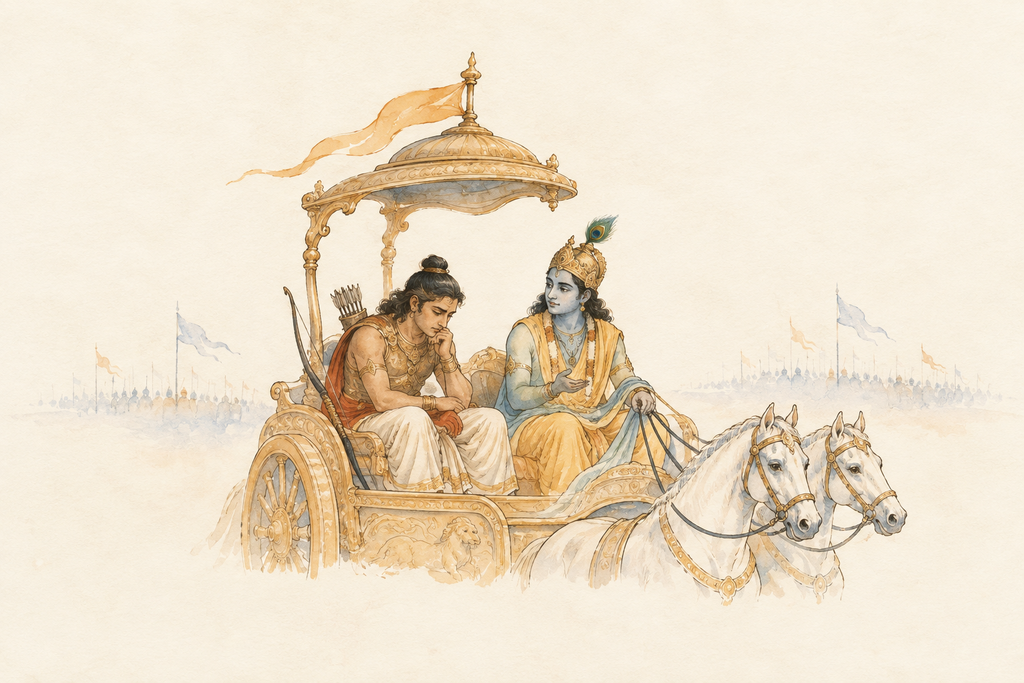
You can be a strong student or athlete and still feel overwhelmed. You can have strong values and still have questions about what to do. Arjun’s uncertainty does not erase his ability. It creates the opening for him to listen and reconsider.
Another idea that stayed with me is acting without being consumed by the reward. In your life, that might mean preparing seriously for an exam, an application, or a tryout while recognizing that the final outcome is never entirely yours to control. Your effort matters. So do honesty, preparation, and how you respond afterward. A single result cannot measure your whole worth.
This is my everyday application of the teaching, not a claim that a school challenge is equivalent to Arjun’s moral crisis. Nor does detachment mean indifference to consequences. The point is to act thoughtfully without letting fear of failure or hunger for recognition govern every choice.
For me, this is part of the value of returning to the texts of an ancient civilization: discovering how people long before us thought about responsibility, humility, and the limits of human control. We bring different lives to these questions, but we can still learn from the depth and seriousness with which earlier generations explored them.
At the end of my Gita reflections, what moved me was that Arjun’s circumstances had not become easy. He had gained clarity about how to face them. Sometimes that is what a good conversation, quiet reflection, or wise guidance can give us: enough clarity to take the next responsible step.
Read more: Episode 72, Episode 73, Episode 74, and Episode 75.
5. Abhimanyu: young people deserve more than praise for being brave
Abhimanyu enters the Chakravyuha, a complex military formation, knowing how to get in but not how to get out. He expects others to follow. They are prevented from reaching him, and experienced warriors surround and kill him.
I find this story especially painful as a mother. The young person’s courage is extraordinary. The failure of the people and rules around him is devastating.
I would never want you to read it as a lesson that you must prove yourself by handling danger alone. In much more ordinary situations—a first job, a difficult team environment, pressure at a party—you are allowed to ask what you do not know, who will support you, and how you can leave. The adults responsible for you should welcome those questions.
In my reflection on these chapters, I asked what remains of victory when people abandon the limits that protect our humanity. Being older, stronger, or more experienced should increase our responsibility toward someone vulnerable.
Read more: Episodes 76–82.
6. The ending: what will be left after you win or lose?
As I approached the end, I kept returning to the grief surrounding the Pandavas’ victory. They recover the kingdom. Their losses remain. Draupadi loses her sons. Parents mourn children. Those who survive must live with what they have done and what has been done to them.
This unsettled my childhood expectation that the right people winning would make everything feel resolved. The story asks us to look beyond the result and consider the people who paid for it.
In your own life, winning an argument, exposing someone publicly, or getting the last word may bring a moment of satisfaction. It is worth asking what outcome you actually want. Accountability? Safety? Repair? Or simply the pleasure of making the other person hurt?
Then, in my grandmother’s final episodes, comes Parikshit, the son of Abhimanyu and Uttara. His survival and restored life through Krishna become, for me, an image of a future still possible after terrible destruction. Learning about him was one of this project’s unexpected gifts. I knew the famous battle much better than I knew this child.
The next generation inherits consequences. It also has the possibility of making different choices.
Read more: Episodes 92–93.
What I hope you carry with you
I hope this gives you a few names to recognize, a little curiosity about the Bhagavad Gita, and a sense of why this story has stayed alive in our family and most Indian families. More than anything, I hope you keep asking questions: about the people you admire, the groups you belong to, the stories you inherit, and your own reasons for acting.
You are allowed to disagree with these characters. You are allowed to disagree with my reflections. I have changed my mind while writing them. Understanding your heritage can include examining it carefully, appreciating its depth, and naming what troubles you.
My grandmother could not have known the world in which you would grow up. Yet something she cared about has reached you through her daughter and granddaughter, across languages, across an ocean, and onto a screen.
That is why I wanted to finish this project. I wanted you to be able to meet a little of her through it—and perhaps discover a little more of yourselves.
If you read just one episode, tell me which character you understood, which choice bothered you, or what you would have done differently. I would love for the next part of this project to be a conversation with you.
Explore my grandmother’s Mahabharata project →
All images in this post are created with the help of ChatGPT and Claude. .


Dearest Tripti,
Excellent effort at trying to understand the deeper meanings hidden in this great Indian epic Mahabharata, and truly in the Bhagwat Geeta which is totally relevant today and will be, forever!
More you explore it, more you will find precious and priceless jewels!
Very happy that you completed this project . Proud of you beta!
♥️♥️♥️♥️♥️